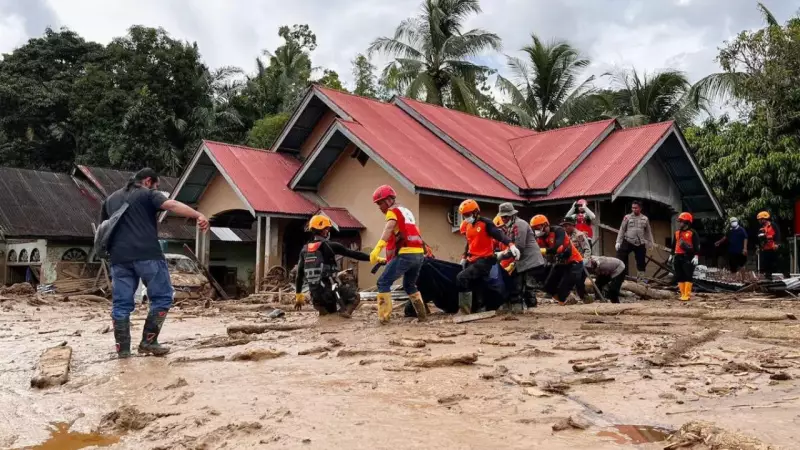
The national disaster agency in Indonesia delivered a grim update on Sunday, announcing a sharp rise in the human cost of severe flooding and landslides. The official death toll has now climbed to 442 people, with the situation remaining critical as 402 individuals are still missing and at least 646 others have been injured.
Struggle to Reach Isolated Communities
Authorities are facing immense challenges in reaching survivors. On Sumatra, the hardest-hit island, at least two cities were completely cut off as of Sunday. In a significant escalation of the relief effort, the government has dispatched two warships from Jakarta to deliver essential aid.
National disaster agency head, Suharyanto, identified the isolated areas in a statement. "There are two cities that require full attention due to being isolated, namely Central Tapanuli and Sibolga," he said. The warships are expected to arrive in Sibolga on Monday, bringing hope to thousands of stranded residents who are without food, water, and medical supplies.

Desperation and Regional Impact
The scale of the disaster has led to desperate scenes. Officials reported on Saturday that people in some areas, driven by a dire need for relief, have resorted to looting supply lines. Meanwhile, in the village of Sungai Nyalo, located about 100 kilometres from West Sumatra’s capital Padang, the floodwaters had largely receded by Sunday. The landscape left behind was one of devastation, with homes, vehicles, and agricultural crops buried under a thick layer of grey mud.
This monsoon disaster is not confined to Indonesia. Neighbouring Thailand is grappling with one of its worst floods in a decade, which has claimed at least 162 lives. The Thai government has announced compensation of up to two million baht ($62,000) for affected households. However, public criticism of the official response is growing, leading to the suspension of two local officials for alleged lapses.
Climate Change Intensifies Annual Monsoon
The extreme weather has broken records. In Thailand's Hat Yai city, a staggering 335 mm (13 inches) of rain was recorded last Friday, marking the highest single-day rainfall in 300 years. In neighbouring Malaysia, the situation is also severe, with around 18,700 people still housed in evacuation centres, although weather warnings have now been lifted.
While the annual monsoon season is a regular occurrence between June and September, experts point to a dangerous intensification this year. A passing tropical storm exacerbated the situation, contributing to some of the deadliest floods in recent memory for both Indonesia and Thailand. Climate scientists warn that climate change is altering storm patterns, making the monsoon season more intense and prolonged, resulting in heavier rains, stronger winds, and more frequent flash floods.