

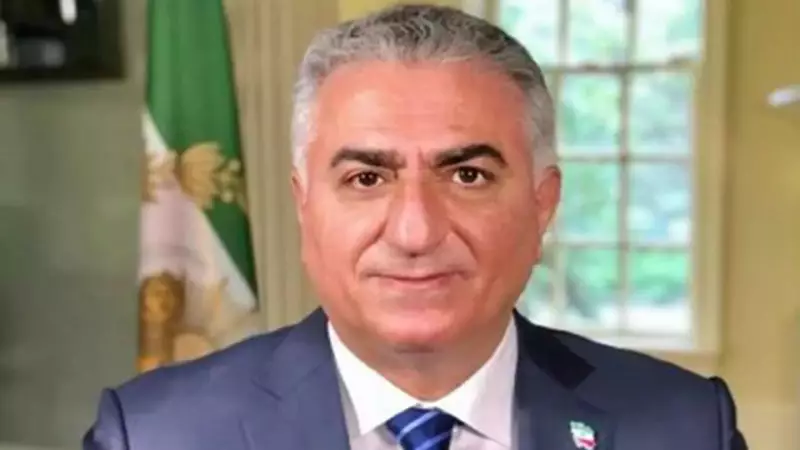
In a dramatic development that could reshape Iran's political landscape, the country's former Crown Prince, Reza Pahlavi, has declared he is preparing to end his decades-long exile and return to his homeland. The announcement comes as Iran grapples with some of the most significant and sustained anti-government protests in years, posing a direct challenge to Supreme Leader Ayatollah Ali Khamenei's authority.
A Royal Call to Action Amid Unrest
Reza Pahlavi, the 65-year-old son of Iran's last Shah, made his intentions clear in a video message and a post on the social media platform X (formerly Twitter) on Saturday. Having lived outside Iran for over five decades, primarily in the United States, Pahlavi directly linked his potential return to the ongoing wave of demonstrations that have swept across Tehran and numerous other cities.
"I, too, am preparing to return to the homeland so that at the time of our national revolution's victory, I can be beside you, the great nation of Iran," he wrote. He expressed a strong belief that the day of victory for the protest movement is "very near." His remarks have electrified many demonstrators who have been openly chanting for his return, seeing him as a symbolic figurehead for opposition to the current Islamic Republic.

Strategic Moves: Strikes and Street Mobilisation
Pahlavi's message went beyond a simple declaration of return; it included a strategic call to action aimed at intensifying pressure on the state. He urged Iranians to target the country's economic lifelines and reclaim public spaces through coordinated civil disobedience.
He specifically called on workers in critical sectors like transportation, oil, gas, and energy to initiate nationwide strikes. Furthermore, he appealed for coordinated street protests over the weekend, asking people to gather from 6 pm carrying national symbols and move towards city centres. "Our goal is no longer merely to be present in the streets; the goal is to prepare for the capture and holding of city centres," Pahlavi stated, signalling a shift towards more assertive tactics.
Praising Protesters and Appealing to Security Forces
In his address, Pahlavi praised the courage of the Iranian people who have continued to demonstrate despite severe threats and a harsh crackdown by security forces. He described the recent protests as "a crushing response" to the leadership's threats.
Notably, he also directed a message to members of Iran's armed and security forces, including the Islamic Revolutionary Guard Corps (IRGC), who have shown sympathy with the protesters. He asked them to "slow down and disrupt the repression machine" so that it could be completely disabled on the "appointed day." This appeal highlights efforts to create fissures within the state's coercive apparatus.
Who is Reza Pahlavi?
Groomed from birth to inherit the Peacock Throne, Reza Pahlavi was undergoing fighter pilot training in the US when the 1979 Islamic Revolution overthrew his father, Shah Mohammad Reza Pahlavi. Forced into exile, he has since become a prominent voice for monarchists and various opposition groups abroad.
However, Pahlavi has consistently stated that he does not seek to restore the monarchy by force. Instead, he advocates for a peaceful transition of power followed by a national referendum to allow Iranians to decide their future system of governance. "This is not about restoring the past. It's about securing a democratic future for all Iranians," he has emphasised in previous statements.
Protests Grip the Nation
The context for Pahlavi's announcement is nearly two weeks of widespread unrest that began over rising living costs but rapidly evolved into a broader movement against the country's clerical establishment. Large crowds have filled streets in Tehran and other cities, chanting slogans directly against Supreme Leader Ayatollah Ali Khamenei.

Human rights groups report that dozens of protesters have been killed and hundreds injured in clashes. The government has responded with a sweeping internet shutdown, a move activists say is intended to stifle communication and hide the true scale of the crackdown. The international community has closely watched the events, with Iran accusing the United States and Israel of fomenting the instability and taking its complaints to the United Nations Security Council.
The potential return of Reza Pahlavi adds a new and unpredictable dimension to an already volatile situation in Iran, marking a pivotal moment in the country's ongoing political struggle.





