

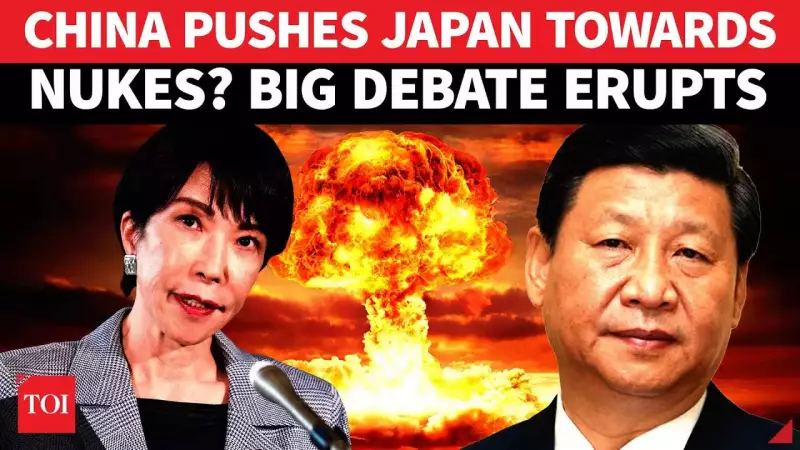
Japan has been forced to publicly restate its long-standing pledge against nuclear arms after a senior official's comments sparked a fierce internal debate. This comes at a time of heightened regional tensions and growing questions about the reliability of American security commitments under a potential second Trump administration.
Official Reaffirmation Amidst Controversial Suggestions
On December 20, 2025, Japan's Chief Cabinet Secretary, Minoru Kihara, firmly stated that the country's policy remains unchanged. He rejected any possibility of Japan possessing, producing, or allowing nuclear weapons on its soil. This declaration was a direct response to reports that a high-ranking security official had suggested the nation should consider acquiring nuclear weapons for deterrence purposes.
The swift clarification from the government underscores the extreme sensitivity of the topic in Japan, the only country to have suffered atomic bombings. However, the mere fact that such a suggestion was made at a senior level has opened a Pandora's box, forcing a reluctant national conversation.

Rising Threats and Shifting Alliances Fuel Debate
The underlying drivers for this debate are powerful and multifaceted. Japanese security planners are increasingly alarmed by the assertive actions of China in regional waters, the continuous missile and nuclear threats from North Korea, and the heightened military posture of Russia in the Far East.
Compounding these external threats is a deep-seated anxiety about the future of the US-Japan security alliance. With former President Donald Trump seeking a return to the White House, his past questioning of American defence commitments to allies has left Tokyo uneasy. This perceived uncertainty has led some lawmakers within Japan's ruling party to cautiously float the idea of nuclear sharing arrangements with the United States, similar to what exists with some NATO allies.
Regional Reactions and the Path Ahead
The internal discussions in Japan have not gone unnoticed. Opposition parties within the country have voiced strong objections, warning of a dangerous shift in post-war pacifist identity. Neighbouring China has issued stern warnings, stating that any move by Japan towards nuclear armament would severely destabilise East Asia and provoke a strong response.
Despite the heated debate, the official line from Tokyo remains steadfast. Japanese leaders insist that the nation's nuclear red line will not be crossed. The three non-nuclear principles are described as a cornerstone of national policy. Yet, the genie is out of the bottle. The public discussion triggered by the official's remarks reveals a nation grappling with an unprecedented security dilemma, where traditional pacifism is being stress-tested by a volatile geopolitical landscape and fears of American retrenchment.
The episode highlights a critical moment for Japanese defence policy. While the government maintains a firm public stance, the private debate signifies a profound re-evaluation of national security options in an increasingly dangerous neighbourhood.






