

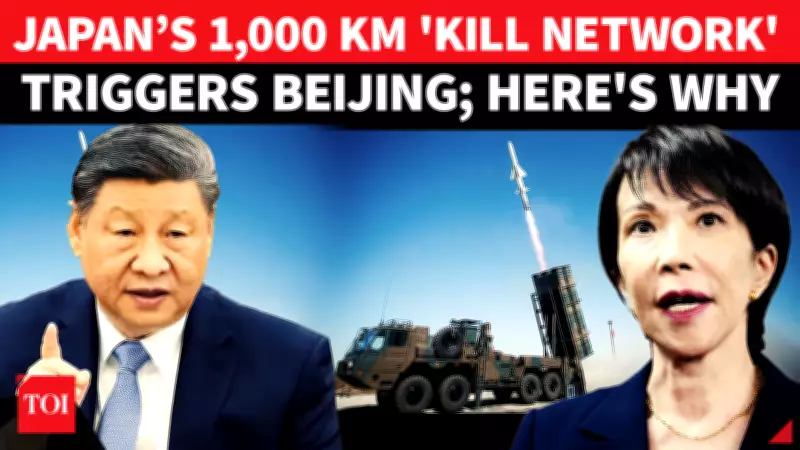
Japan's Enhanced Missile Capability Raises Regional Security Concerns
In a development that has significantly escalated military tensions in East Asia, Japan's deployment of upgraded long-range Type-12 missiles has drawn a sharp response from China. The new missile system, with its vastly extended reach, is being viewed by Chinese analysts as a potential component of a sophisticated "kill network," capable of preemptive strikes across vast distances, including deep into neighboring territories.
From Defense to Offense: The Type-12 Missile Upgrade
The core of this controversy lies in the enhanced capabilities of the Type-12 missiles. Previously restricted to a range of approximately 200 kilometers, the upgraded version now boasts a striking distance of nearly 1,000 kilometers. This dramatic increase transforms the system from a primarily defensive tool into a formidable offensive asset, raising alarms about its strategic implications.
Japan is set to deploy these missiles in Kumamoto, located on the island of Kyushu, a move that positions them strategically to cover extensive areas. The concept of a "kill chain"—a coordinated system designed to detect, target, and eliminate threats rapidly—has become a focal point of concern, with fears that these missiles could enable strikes before adversaries even detect an incoming attack.

China's Strong Reaction and Regional Implications
China has reacted strongly to Japan's military advancement, interpreting it as a shift towards more aggressive posturing in the region. Chinese military experts have labeled the deployment as part of a broader "kill network," suggesting it could undermine regional stability and escalate arms competition.
The timing of this development adds to the geopolitical tensions in East Asia, where territorial disputes and historical animosities already simmer. The enhanced missile range allows Japan to project power far beyond its immediate borders, potentially altering the balance of military deterrence and prompting countermeasures from neighboring countries.
Broader Context and Future Outlook
This missile upgrade is part of Japan's ongoing efforts to bolster its defense capabilities amid growing security challenges in the Asia-Pacific region. As nations in the area modernize their militaries, such advancements often trigger a cycle of responses, heightening the risk of miscalculation or conflict.
The deployment in Kumamoto underscores Japan's commitment to enhancing its strategic autonomy, but it also raises questions about the future of diplomatic relations and arms control in East Asia. Observers warn that without careful management, this development could lead to increased militarization and instability, affecting global security dynamics.






