

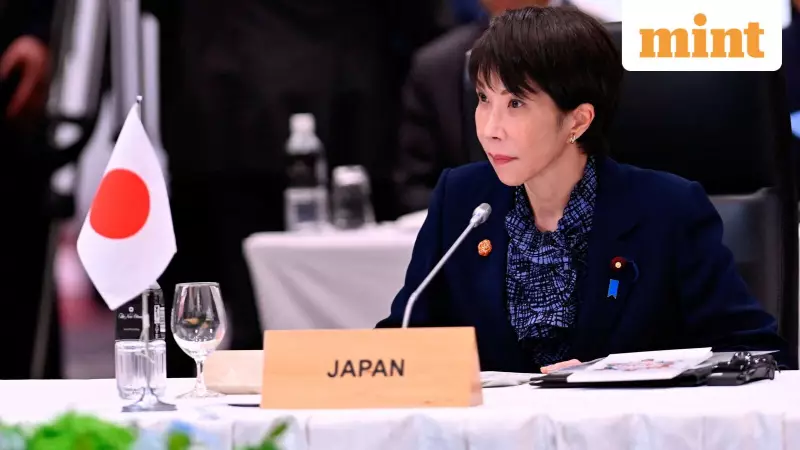
Last month, Japanese Prime Minister Sanae Takaichi's suggestion of a potential military response if China moved against Taiwan triggered a sharp reaction from Beijing. China's angry statements and increased warplane activity sent a clear message: back off. However, the stark geopolitical and economic realities mean that a conflict over Taiwan is very much Japan's business, with its own security and national interests directly on the line.
The Geostrategic Stakes for Japan
Taiwan's location is a crucial maritime crossroads, with a massive portion of global trade flowing through the adjacent South and East China Seas. Strategic chokepoints like the Bashi Channel skirt the island's edges. A successful Chinese conquest would allow Beijing to dominate these vital waterways, project power deep into the Pacific, and aggressively push its disputed territorial claims.
Robert Ward, Japan chair at the International Institute for Strategic Studies, warns that "the balance of power in Asia would be tipped quite decisively in favor of China should Taiwan fall." He notes that China is currently "hemmed in" by the First Island Chain—a string of archipelagos including Japan, Taiwan, and the Philippines. Taking Taiwan would be a key step for Beijing to break out of this containment.

Japan's Frontline Position and Military Buildup
Geography places Japan perilously close to any Taiwan conflict. The Ryukyu Islands arc southwest, with Yonaguni Island lying less than 70 miles from Taiwan but over 1,200 miles from Tokyo. In a war scenario, these islands could find themselves in or adjacent to the combat zone, risking Japanese citizens and territory from blockades, missile strikes, and naval clashes. Vital shipping lanes Japan depends on would be severely disrupted.
In response to China's military rise, Tokyo has significantly bolstered its southwestern defenses. Investments include new bases, radar facilities, and missile systems. Type 12 anti-ship missile batteries with a 125-mile range are now deployed across the Ryukyus, with longer-range variants in development. Yonaguni is slated to receive surface-to-air missiles.
The territorial dispute over the Senkaku Islands (Diaoyu to China) adds another layer of tension. Located just over 100 miles northeast of Taiwan and controlled by Japan, these uninhabited islets are routinely patrolled by Chinese coast guard vessels. Yuki Tatsumi of the Institute for Indo-Pacific Security states that a Chinese takeover of Taiwan would remove a strategic buffer, exposing Japan to direct pressure from the Chinese navy and making the threat to its territory more acute.
The Indispensable Role of US Bases in Japan
Japan's involvement is not just about its own defense; it is the linchpin for any effective US military intervention. The US maintains a network of strategically vital bases in Japan, supported by robust infrastructure not available elsewhere in Asia.
Kadena Air Base in Okinawa is a hub of US air power in the Pacific, hosting fighters crucial for operations in the Taiwan Strait. The US Navy base at Yokosuka is home to the Seventh Fleet. Eric Heginbotham of MIT's security studies program emphasizes, "The U.S. doesn't really have anything like the bases that it has in Japan elsewhere in Asia. You can't replicate what you have in Japan."
A 2023 CSIS wargame report co-authored by Heginbotham described Japan as essential, stating, "The United States must be able to use its bases in Japan for combat operations." Without access to Japanese bases, the US would be heavily reliant on distant Guam for fighter operations, which is unsustainable for maintaining air superiority over Taiwan.
However, this concentration of forces also makes Japan a target. China's vast arsenal of missiles threatens to overwhelm fixed bases. In a conflict, the US would likely disperse aircraft to various Japanese military and civilian airfields, potentially drawing Japan deeper into the fight.

Legal, Political, and Escalation Risks
Japan's degree of participation in a conflict would hinge on a complex mix of military, legal, and political calculations. Washington's policy of "strategic ambiguity" regarding direct intervention adds to the uncertainty. If the US did decide to defend Taiwan, decisions made in Tokyo would fundamentally shape the scope and effectiveness of that intervention.
Japan could also be dragged into hostilities by China's actions. If Beijing believed US involvement was likely, it might launch pre-emptive missile barrages against US bases in Japan, potentially striking Japanese targets as well. The proliferation of missile capabilities is evident on all sides, with the US recently deploying its Typhon system and the new Marine Corps NMESIS missile battery to Japan for exercises.
The intertwined fate of Taiwan, the US, and Japan creates a formidable deterrent but also a complex tripwire. As tensions simmer, Japan's southwestern islands are no longer a quiet periphery but a potential frontline, with Tokyo's security posture evolving to meet an unprecedented challenge directly on its doorstep.





