

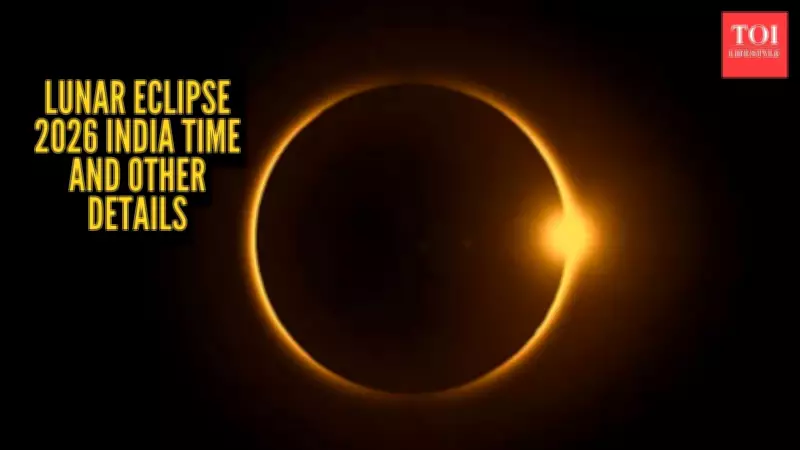
India to Witness Partial Lunar Eclipse on March 3, 2026 During Holi
If you enjoy gazing at the night sky or simply need a reason to step outside for a peaceful moment, mark your calendar for March 3, 2026. On this date, India will have the opportunity to observe a lunar eclipse, albeit for a brief period. This celestial event coincides with the festive occasion of Holi, creating a unique intersection of science and tradition on the same calendar day.
Lunar Eclipse 2026: Detailed Timings and Phases in India
The lunar eclipse of March 3, 2026, will unfold gradually throughout the afternoon and evening. According to precise astronomical calculations, the key phases in Indian Standard Time (IST) are as follows:
- Penumbral Phase: 2:14 PM to 4:58 PM
- Partial Eclipse Begins: 3:20 PM
- Total Lunar Eclipse Begins: 4:34 PM
- Maximum Eclipse: 5:03 PM
- Total Phase Ends: 5:32 PM
- Eclipse Ends Completely: Between 6:47 PM and 7:53 PM
It is important to note that these timings represent the complete eclipse cycle, but visibility in India will be limited due to the Moon's position relative to the horizon.

What Will Skywatchers in India Actually See?
Expectations for viewing the eclipse in India require a slight adjustment. In major metropolitan areas such as Delhi, Mumbai, and Bengaluru, the Moon will rise close to sunset. Consequently, the most dramatic phases of the eclipse, including the total lunar eclipse, will occur while the Moon is still below the horizon.
When the Moon becomes visible in the sky, the eclipse will already be in its concluding stages. Observers can anticipate seeing a Moon that appears slightly dimmed or partially shadowed. Under clear atmospheric conditions, there is a possibility of catching a faint reddish tint, often referred to as a Blood Moon, before the Moon gradually returns to its normal brightness.
Viewers in northeastern states, including Assam, Arunachal Pradesh, and Meghalaya, may enjoy a slightly extended viewing opportunity, as the Moon rises earlier in these regions compared to other parts of India.
The Science Behind the Red Moon Phenomenon
During a lunar eclipse, Earth positions itself directly between the Sun and the Moon, casting its shadow across the lunar surface. However, the Moon does not vanish entirely from view. Instead, sunlight bends as it passes through Earth's atmosphere, scattering and allowing red and orange wavelengths to reach the Moon. This process is identical to the mechanism that creates the fiery and warm hues observed during sunsets.
The filtered light that reaches the Moon is responsible for imparting the characteristic reddish glow, transforming it into what is popularly known as a Blood Moon during total eclipses.
Viewing Requirements and Equipment
One of the most appealing aspects of lunar eclipses is that they require no special equipment for safe viewing. Unlike solar eclipses, lunar eclipses pose no risk to the eyes, making protective glasses unnecessary. Telescopes or binoculars are not required, though they can enhance the experience.
To optimize your viewing, simply locate a spot with a clear eastern horizon and minimal ambient light pollution. This will provide the best chance to observe the partially eclipsed Moon as it rises.
Future Lunar Eclipses in 2026
Another lunar eclipse is scheduled for August 28, 2026; however, it will not be visible from India. Therefore, the March 3 eclipse represents the sole opportunity for Indian astronomy enthusiasts and casual skywatchers to witness a lunar eclipse in that year.

Key Takeaways for the March 3, 2026 Lunar Eclipse
- Date: March 3, 2026
- Visibility in India: Yes, but only during the final phase
- Optimal Viewing Time: Around sunset, approximately 6:20 PM onward, depending on your specific location
- Expected Sight: A partially eclipsed Moon rising, potentially with a soft red hue
Ultimately, the charm of this event lies in its simplicity. There are no crowds to navigate, no tickets to purchase, and no elaborate planning required. Just step outside, look upward, and witness the sky perform its quiet, majestic spectacle.





