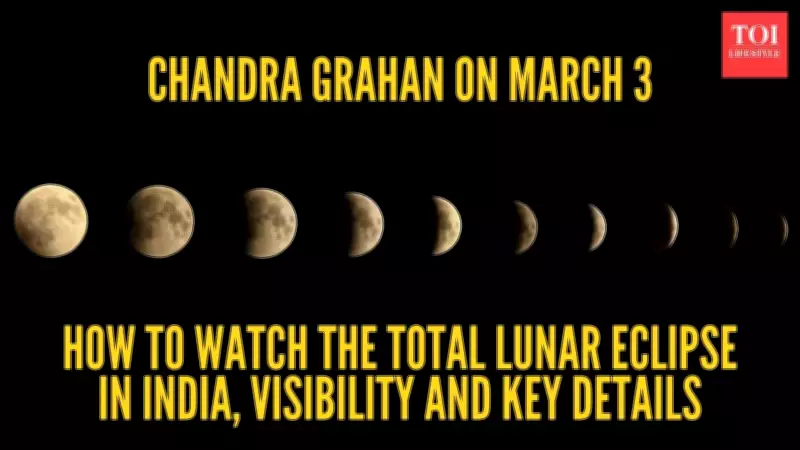
First Lunar Eclipse of 2026 to Grace Indian Skies on March 3
For astronomy enthusiasts and casual skywatchers alike, March 2026 offers a celestial spectacle worth marking on calendars. On Tuesday, March 3, 2026, the year's inaugural lunar eclipse, traditionally called Chandra Grahan, will occur. This natural event provides a simple yet captivating opportunity to observe the heavens, requiring no advanced planning or specialized gear—just a clear evening sky and a few moments of your time.
Visibility and Timings for Indian Observers
Residents across India will have the chance to witness this lunar phenomenon, albeit with a limited viewing window. According to detailed astronomical reports, including one from The Times of India Astrology dated January 30, only the concluding segment of the eclipse will be visible from the subcontinent. This is because the Moon will already be immersed in Earth's shadow as it ascends above the horizon in most Indian regions.
The most observable phase is anticipated around sunset, offering a brief but mesmerizing glimpse lasting approximately 20 minutes as the Moon gradually emerges from the terrestrial shadow. This timing means you won't need to sacrifice sleep; simply venture outdoors during dusk and direct your gaze skyward.

Detailed Eclipse Schedule in Indian Standard Time (IST)
Based on authoritative sources like Time and Date, the eclipse unfolds as follows:
- Start of penumbral phase: 4:58 PM IST
- Start of totality: 4:58 PM IST
- End of totality: 5:32 PM IST
- End of penumbral phase: 7:53 PM IST
It's crucial to note that the visible portion for India aligns with the later stages, making sunset the optimal viewing time.
The Science Behind a Lunar Eclipse
A lunar eclipse transpires when Earth positions itself directly between the Sun and the Moon. This alignment causes our planet's shadow to fall upon the lunar surface, resulting in a noticeable darkening. In certain instances, the Moon may adopt a subtle reddish hue due to atmospheric scattering of sunlight. While lunar eclipses are not exceedingly rare, occurring several times annually, their visibility from specific locations like India is less frequent, lending this event a distinctive appeal.
Practical Viewing Tips for Optimal Experience
Observing a lunar eclipse is remarkably straightforward and safe. Unlike solar eclipses, which demand protective eyewear, lunar eclipses can be enjoyed with the naked eye without any risk. If meteorological conditions cooperate, step outside to an unobstructed area and look up at the Moon.
While binoculars can enrich the viewing experience by revealing finer details, they are entirely optional. The key factor is clear weather, so checking local forecasts beforehand is advisable to ensure optimal visibility.
Significance and Cultural Context
Beyond its visual allure, a lunar eclipse serves as a profound reminder of the precise orbital mechanics governing our solar system. It highlights the intricate dance of the Sun, Earth, and Moon, offering a moment of cosmic reflection. For many communities, eclipses carry deep cultural and traditional meanings, often woven into rituals and beliefs.
The March 3 eclipse, though brief in its Indian appearance, presents a valuable opportunity to pause, appreciate the natural world, and partake in a shared celestial observation. Remember to monitor weather updates, as clear skies will significantly enhance this astronomical event.