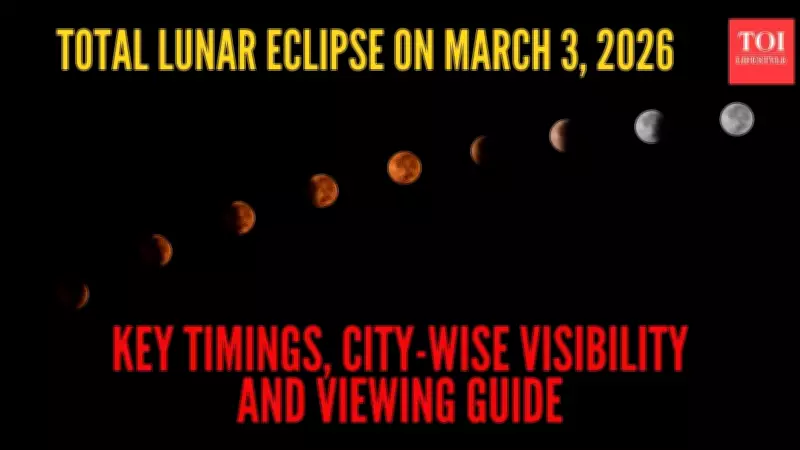
March 3, 2026: A Celestial Event for Indian Skywatchers
March 3, 2026, marks a significant astronomical occasion for observers across India. This date will host the first lunar eclipse of the year, commonly referred to as Chandra Grahan. Unlike many events that require tickets, extensive planning, or protective gear, this natural spectacle demands only a few free evening minutes and an unobstructed view of the heavens. For countless individuals throughout the nation, it presents a brief yet fascinating opportunity to pause daily routines and gaze upward.
Total Lunar Eclipse 2026: Date and Key Timings in India
According to data from Time and Date, the eclipse phases will unfold in Indian Standard Time as follows:
- Start of penumbral phase: 4:58 PM IST
- Start of totality: 4:58 PM IST
- End of totality: 5:32 PM IST
- End of penumbral phase: 7:53 PM IST
An important consideration for viewers in India is that the Moon will already be in eclipse as it rises in numerous regions. Consequently, only the concluding segment of the eclipse will be observable from the country. The most prominent phase for Indian enthusiasts is anticipated around sunset, with a visible window lasting approximately 20 minutes as the Moon gradually exits Earth's shadow. Therefore, there is no necessity to stay awake late into the night; simply venture outdoors around dusk and direct your gaze toward the ascending Moon.

City-Wise Visibility: Where Totality Will Be Witnessed in India
Based on publicly accessible information from Time and Date, several cities in Northeast India will experience totality, characterized by 100 percent obscuration. Below are selected locations where the total phase will be visible:
- Dibrugarh, Assam
- Obscuration: 100 percent
- Start: 14:14
- Maximum: 17:11
- End: 19:53 IST
- Totality duration: 3 hours 27 minutes 8 seconds
- Dispur, Assam
- Obscuration: 100 percent
- Start: 14:14
- Maximum: 17:25
- End: 19:53 IST
- Totality duration: 3 hours 27 minutes 8 seconds
- Guwahati, Assam
- Obscuration: 100 percent
- Start: 14:14
- Maximum: 17:25
- End: 19:53 IST
- Totality duration: 3 hours 27 minutes 8 seconds
- Itanagar, Arunachal Pradesh
- Obscuration: 100 percent
- Start: 14:14
- Maximum: 17:17
- End: 19:53 IST
- Totality duration: 3 hours 27 minutes 8 seconds
- Shillong, Meghalaya
- Obscuration: 100 percent
- Start: 14:14
- Maximum: 17:25
- End: 19:53 IST
- Totality duration: 3 hours 27 minutes 8 seconds
These urban centers will encounter complete coverage during the total phase, as indicated by the 100 percent obscuration metric in the data. Source: Time and Date
The Science Behind a Lunar Eclipse
A lunar eclipse transpires when Earth positions itself directly between the Sun and the Moon. During this precise alignment, Earth's shadow is cast upon the lunar surface. This shadowing effect can cause the Moon to appear darker than usual, and in certain instances, it may exhibit a subtle reddish hue. Lunar eclipses occur several times annually, but not every event is visible from India, which renders the March 3, 2026, eclipse particularly noteworthy for local observers.
How to Observe the March 3 Lunar Eclipse
Viewing a lunar eclipse is straightforward and accessible. No protective eyewear is required, as it is entirely safe to observe with the naked eye, unlike solar eclipses. If atmospheric conditions are clear, you can simply step outside and look up at the Moon. Binoculars may offer a closer perspective, but they are optional. Even without any optical aids, the alteration in the Moon's appearance will be distinctly perceptible.
As March approaches, this date is one that many astronomy enthusiasts may wish to mark on their calendars. Although the visible window may be brief, even a momentary glimpse of such a celestial phenomenon can evoke a sense of wonder and significance.