A wave of mob violence is reshaping Bangladesh's political landscape, moving from the fringes to the centre of what is being termed 'New Politics'. This shift comes in the aftermath of the assassination of a popular independent figure, revealing a deep institutional vacuum and a dangerous normalisation of public retribution.
The Spark: Assassination and Ensuing Chaos
The catalyst for the recent unrest was the killing of Sharif Osman Hadi, a 'Young Turk' who rose to prominence after the July uprising. Known for his independence from established parties, Hadi was shot by assailants on a bike a few days ago and later succumbed to his injuries. His death on December 22, 2025, acted as a trigger, unleashing a series of violent incidents across Dhaka.
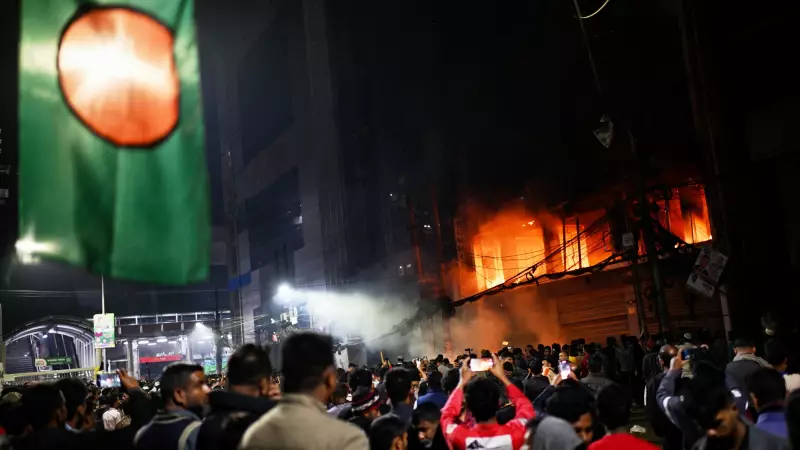
In the days that followed, a mob ran loose. The violence was targeted and symbolic. A Hindu factory worker was brutally lynched. The offices of two leading national dailies, Prothom Alo and The Daily Star, were attacked. Arsonists targeted two prominent cultural institutions and set fire to the houses of at least two politicians. The Mujib Museum was, in a grim ritual, demolished once again. These targets were branded by the perpetrators as 'agents of India'—a codeword for media and cultural organisations perceived as opposing the mob's ideology.

Old Politics vs. New: A Nation's Radical Turn
Analysts point out that these acts are not random but represent a deliberate burning down of what is called 'Old Politics'. This old order, embodied by parties like the Awami League and the BNP, is accused of corruption and state overreach. The arson and attacks are seen as the painful birth pangs of a promised 'New Republic'.
Despite the Awami League being banned and its leader on death row, the champions of New Politics continue to see its hidden hand everywhere, extending their witch-hunt to its 'ghost'. This, experts argue, is a true sign of radicalisation. The BNP, too, is increasingly painted with the same brush as part of the discredited old guard.
The interim government appears powerless. The shock expressed by the Chief Advisor’s press secretary, Shafiqul Alam, was telling. After failing to prevent the attacks on newspapers, he wrote of wanting to 'dig up a great piece of earth and bury myself in shame,' having earlier dismissed such violence as mere pressure-group tactics.
The Vacuum of Restraint and a Troubled Future
Perhaps more disturbing than the violence itself is the lack of a significant counter-force advocating for peace and restraint. Bangladesh has no equivalent of India's Aam Aadmi Party to stage a Gandhian fast, or a figure like Rahul Gandhi to visibly embrace the victims. There is a profound absence of an institution that can embody a moderate moral conscience.
The fundamental impulse of this New Politics, as evidenced in every violent spike, is an unrestrained, celebratory eruption of public retribution. While the old system had its vices, the new one offers no constitutional hope, only the immediate gratification of mob justice. The nation's aspiration for peace and prosperity lacks a political champion for the one thing that makes it possible: restraint.
The tragedy for Bangladesh is that the birth of its envisioned new Republic is being marked not by democratic renewal, but by the glow of burning newsrooms and the smoke of burning bodies. The voice of the mob is being dangerously legitimised as the authentic cry of a subaltern nation, leaving a scar that will be difficult to heal.