

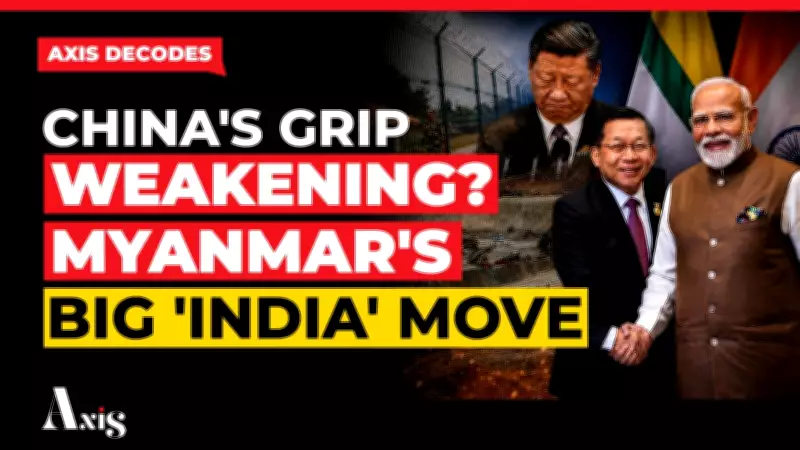
Myanmar's President Min Aung Hlaing has arrived in India at a crucial moment in Asian geopolitics. For decades, Myanmar has balanced between major powers, but China's growing influence, control over infrastructure, access to critical minerals and deep involvement in Myanmar's economy have created concerns inside Naypyidaw. India sees an opportunity. Myanmar is not just another neighbour. It is India's gateway to Southeast Asia, the key to securing the Northeast, a crucial partner in connectivity projects like Kaladan and a major source of rare earth minerals essential for semiconductors, electric vehicles and advanced defence systems. As China tightens its strategic grip, Myanmar appears to be searching for alternatives. India is offering partnership without domination, connectivity without debt traps and cooperation without coercion. But civil war, insurgencies and political instability make every calculation complicated. This is the story of why Myanmar has become one of the most important geopolitical battlegrounds in Asia today.
China's Strategic Hold on Myanmar
China has long been Myanmar's dominant economic and political partner. Through the Belt and Road Initiative, Beijing has invested heavily in ports, pipelines, and railways, including the Kyaukphyu deep-sea port and oil and gas pipelines that bypass the Strait of Malacca. Chinese firms control much of Myanmar's rare earth mining, which supplies over 90% of the world's heavy rare earth elements. This dependence has given China significant leverage over Naypyidaw, influencing everything from trade policy to internal security. Myanmar's military leadership, however, has grown wary of this over-reliance, particularly as China's strategic interests increasingly align with those of ethnic armed groups along the border.
India's Offer: Partnership Without Strings
India presents itself as a more balanced alternative. New Delhi has proposed enhanced connectivity through the Kaladan Multi-Modal Transit Transport Project, which links India's Northeast to Myanmar's Sittwe port, and the India-Myanmar-Thailand Trilateral Highway. These projects aim to boost trade and reduce isolation for India's northeastern states. Additionally, India has offered training and capacity-building for Myanmar's military and civil services, as well as cooperation in renewable energy and digital infrastructure. Unlike China, India emphasizes democratic values and mutual respect, though it has maintained ties with Myanmar's junta despite international criticism.

Rare Earths: The Strategic Prize
Myanmar is the world's third-largest producer of rare earth elements, critical for high-tech industries. China dominates the global supply chain, but Myanmar's deposits offer an alternative source. India, which has its own rare earth reserves but limited processing capacity, sees Myanmar as a key partner to reduce dependence on Beijing. Joint ventures in mining and processing could help both countries secure supply chains for defense, electric vehicles, and renewable energy. However, the ongoing civil war and Chinese influence over mining regions pose significant challenges.
The Civil War Complication
Myanmar's internal conflict, with multiple ethnic armed groups and pro-democracy forces fighting the junta, complicates any foreign partnership. China has leveraged ties with some ethnic groups, such as the United Wa State Army, to exert pressure on Naypyidaw. India, while supporting stability, has limited influence over these groups. The violence also threatens infrastructure projects and rare earth mining operations. For Myanmar's leadership, deeper ties with India must be balanced against the risk of alienating China or provoking domestic backlash.
Geopolitical Implications
Myanmar's pivot toward India could reshape Asian geopolitics. It would give India a stronger foothold in Southeast Asia, countering China's growing assertiveness in the South China Sea and along the Indo-Pacific. For the United States and its allies, a more independent Myanmar could open up new supply chains for critical minerals. However, any shift will be gradual, as China remains Myanmar's largest trading partner and investor. The success of India's overture depends on its ability to deliver tangible benefits without exacerbating instability.

In conclusion, Myanmar's President Min Aung Hlaing's visit to India marks a potential turning point. As China's shadow looms large, Naypyidaw is exploring alternatives. India offers a compelling vision of partnership, but the path is fraught with challenges from civil war, insurgencies, and great-power rivalry. The outcome will have lasting implications for Asia's strategic landscape.





