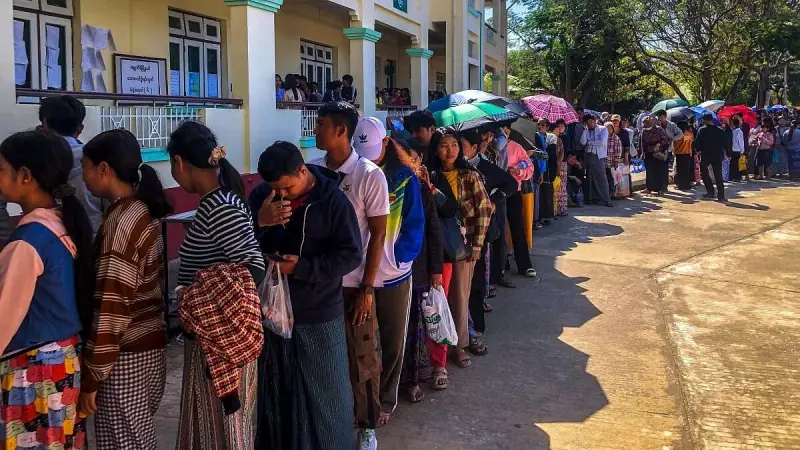
In an election widely scrutinized by the international community, voters in Myanmar went to the polls on December 28, 2025, in an atmosphere dominated more by apprehension than by democratic aspiration. The polls, the first since the military seized power in a 2021 coup, were marked by reports of coercion and a lack of genuine choice.
The Symbolism of an Inked Finger
The visual narrative from the capital, Naypyidaw, was stark. Senior General Min Aung Hlaing, the leader who orchestrated the 2021 coup, was photographed leaving a polling station with a broad grin. He prominently displayed his left hand, with the pinkie finger dyed a deep purple ink—the official mark indicating he had cast his ballot. This image, circulated by state media, was intended to project an aura of legitimacy and normalcy to the contested electoral process.
An Election Under Duress
Analysts and reports from within the country suggest that for many ordinary citizens, participation was not an exercise in hope. Instead, it was an act performed under significant pressure and fear of repercussions. The military junta, which has ruled with an iron fist since overthrowing the civilian government, framed the election as a necessary step toward disciplined democracy. However, major opposition parties, including the National League for Democracy (NLD), had been dissolved, and their leaders remain imprisoned or in hiding.

International observers and independent media were largely barred from monitoring the proceedings, raising serious questions about transparency and fairness. The vote is seen by critics as a maneuver by the military to cement its control under a veneer of electoral approval, rather than a genuine return to civilian rule.
Regional Repercussions and Global Stance
The outcome of this election is poised to have significant implications for the region, including India, which shares a long and porous border with Myanmar. New Delhi has maintained a complex diplomatic balancing act, engaging with the junta on security and border management while expressing concern over the democratic backslide. The election is unlikely to lead to a swift normalization of Myanmar's relations with Western nations, which have imposed sanctions on the junta and its leaders.
The broader consequence is a deepening of the political and humanitarian crisis in Myanmar. With the military seeking to legitimize its rule through a managed election, the prospects for a peaceful resolution and the restoration of rights for the Myanmar people appear dim. The event of December 28, 2025, may thus be remembered not as a day of democratic renewal, but as a chapter in the consolidation of authoritarian rule.