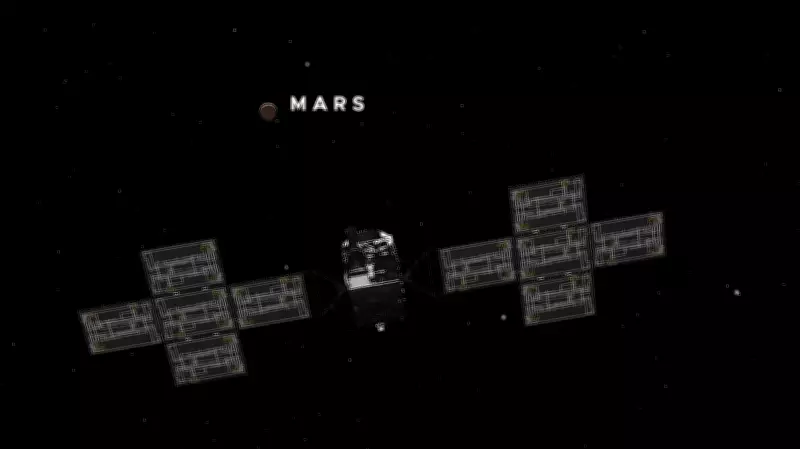
NASA's Psyche spacecraft is on course for a critical gravity assist maneuver around Mars, which will propel it toward its destination: the metal-rich asteroid 16 Psyche. The probe, launched in October 2023, is expected to fly by Mars in early May 2026, using the planet's gravity to gain speed and adjust its trajectory.
Mission Objectives
The Psyche mission aims to study a unique asteroid believed to be the exposed core of an early planet, offering insights into the building blocks of planetary formation. The asteroid, located in the main asteroid belt between Mars and Jupiter, is thought to be composed largely of nickel and iron.
Gravity Assist Details
During the Mars flyby, the spacecraft will come within approximately 500 kilometers of the Martian surface. The gravity assist will increase Psyche's velocity by about 2.5 kilometers per second, setting it on a course to intercept asteroid 16 Psyche in August 2029. This maneuver is crucial for conserving fuel and reducing travel time.

- Flyby date: Early May 2026
- Closest approach: ~500 km from Mars
- Velocity boost: 2.5 km/s
Scientific Significance
Upon arrival, Psyche will orbit the asteroid for approximately 26 months, mapping its surface and studying its composition. Scientists hope to determine whether the asteroid is indeed a planetary core, which could provide clues about the violent history of the solar system.
The mission is led by Arizona State University and managed by NASA's Jet Propulsion Laboratory. It is part of NASA's Discovery Program, which focuses on cost-effective, focused science missions.
Future Prospects
If successful, Psyche will be the first spacecraft to visit a metal world, opening new avenues for understanding planetary interiors. The data collected could also have implications for asteroid mining and resource utilization in space.
The spacecraft carries a suite of instruments, including a multispectral imager, a gamma-ray and neutron spectrometer, and a magnetometer, to analyze the asteroid's properties.