

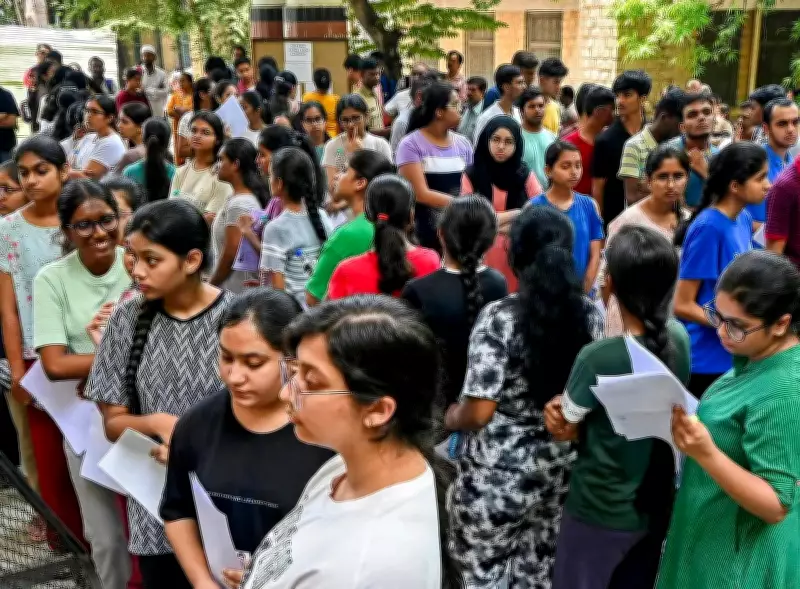
NEW DELHI: Nearly two in five NEET (UG) aspirants this year came from just four states, highlighting the concentration of India's medical education aspirants, even as the overall exam base continues to expand.
Data from the National Testing Agency's state-wise report for NEET (UG) 2026 shows that Uttar Pradesh, Maharashtra, Rajasthan, and Bihar together accounted for about 9.4 lakh candidates, or 41.4% of the total 22.7 lakh candidates for the exam. Overall participation remained high. Of the 22.7 lakh candidates, over 22 lakh appeared, translating into an attendance rate of 96.9%. A total of 69,976 candidates were absent, or 3% of those allotted centers.
The four largest states also topped the list individually. Uttar Pradesh recorded the highest allocation at around 3.6 lakh candidates, followed by Maharashtra with 2.2 lakh, Rajasthan with 2 lakh, and Bihar with 1.5 lakh. Other high-volume states included Karnataka (1.5 lakh), Tamil Nadu (1.4 lakh), Madhya Pradesh (1.2 lakh), Kerala (1.1 lakh), and West Bengal (1 lakh). Together, the top nine states — from Uttar Pradesh to West Bengal — accounted for over 17 lakh candidates, or roughly three-fourths of the total pool, indicating a sharp clustering of aspirants in a limited set of large states.

In contrast, several smaller states and Union territories reported allocations below 5,000 candidates, underlining the uneven geographic spread of participation. However, attendance levels were consistently high across states. Gujarat recorded the highest attendance rate at 98.1%, followed by Puducherry at 98%, and Rajasthan at 97.9%. Among large states, Uttar Pradesh (97.5%) and Maharashtra (97.4%) also reported strong turnout. Kerala had the lowest attendance rate among major states at 94.4%, followed by Assam (95.1%) and Tamil Nadu (95.9%).
This data underscores the significant regional disparities in medical education aspirants, with a heavy concentration in a few populous states. The high overall attendance rate indicates strong commitment among candidates, even as the geographic distribution remains skewed.






