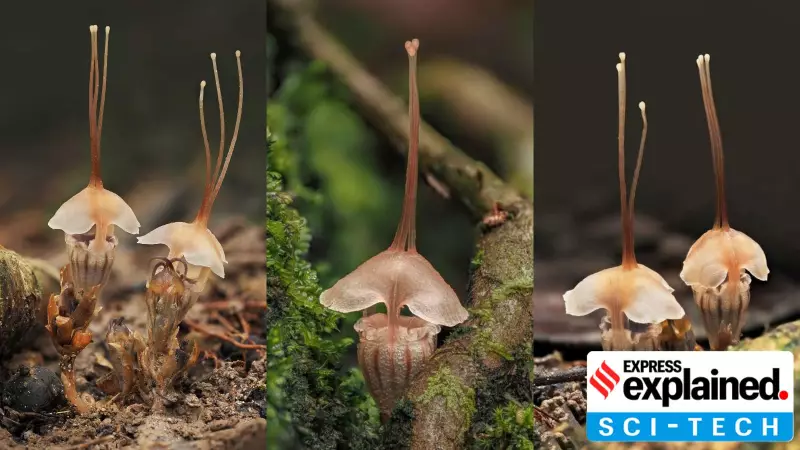
In a remarkable discovery that highlights the hidden wonders of tropical forests, a bizarre new species of parasitic plant, dubbed the 'fairy lantern,' has been identified near Kuala Lumpur, Malaysia. This peculiar organism, which spends most of its life hidden underground, represents a fascinating cheat in the natural world's economy.
The Accidental Discovery in a Recreational Forest
The story of this discovery begins not with a formal scientific expedition, but with the keen eye of a passionate naturalist. In November 2023, Gim Siew Tan, a photographer and nature enthusiast, was exploring the Sungai Congkak Recreational Forest, initially on the hunt for slime molds. Her trained observation, honed by looking for tiny forest floor dwellers, spotted something unusual poking through the leaf litter.
"Spending time looking for slime molds trained me to notice the tiniest things," Tan recalled. The object of her curiosity was a small, pinkish flower with a distinctive umbrella-shaped dome and three strange, tentacle-like extensions. Intrigued by its "pretty and unique" appearance, she photographed it and uploaded the images to iNaturalist, a popular platform for identifying biodiversity.

These images quickly captured the attention of Dr. Siti Munirah, a botanist at the Forest Research Institute Malaysia. She immediately recognized it as a potential new species. Following this digital clue, Tan, Siti Munirah, and their colleagues conducted field surveys and formally described the plant in a study published in the journal PhytoKeys in late 2025. They named it Thismia selangorensis.
Understanding the 'Fairy Lantern': A Master of Deception
So, what makes this plant so extraordinary? The fairy lantern belongs to a rare group of plants known as mycoheterotrophs. To understand its lifestyle, one must first understand the norm. For over 500 million years, most plants have engaged in a symbiotic partnership with mycorrhizal fungi in the soil. The plant provides sugars from photosynthesis, and the fungi supply water and nutrients—a fair trade.
Thismia selangorensis is a cheat. It is a full parasite that steals all its energy and nutrients from these fungi, offering nothing in return. This is only possible because the fungi are themselves connected to other, photosynthetic plants. "Mycoheterotrophs cheat this system by taking without giving anything in return," explained Vincent Merckx, a biologist at the Naturalis Biodiversity Center in the Netherlands. He notes that only about 550 species of such plants are known worldwide, a tiny fraction of Earth's plant diversity.
The physical form of the fairy lantern is as strange as its diet. Its most notable feature is an "extraordinarily wide" umbrella-like dome, called a mitre, atop the flower. Michal Sochor, a botanist at Palacký University, suggests this shape may help keep debris and rainwater out of its delicate internal structure. The purpose of its three tentacles remains a mystery, though they might emit chemicals to signal its presence above the leaf litter.
A Rare and Endangered Find
The discovery underscores both the richness of undiscovered life and its fragility. Despite extensive searches in the area, researchers have located only about 20 individual plants to date. Some were even found living within tree hollows. Given this extremely limited population and tiny geographical range confined to the forest near Kuala Lumpur, Dr. Siti Munirah argues the species should be considered Critically Endangered.
The plant's elusive nature adds to the challenge. Like its relatives, it spends most of its life underground, emerging to flower only at unpredictable intervals. The genus Thismia contains over 110 known species, primarily in tropical Asia and the Americas, with new ones reported annually. Yet their biology holds many secrets, including exactly which fungus Thismia selangorensis exploits and the full function of its unusual anatomy.

The discovery also echoes a botanical mystery: a related species, Thismia americana, was found in a prairie outside Chicago in 1912, thousands of miles from any known relative. It vanished after a barn was built on the site, and its origin story remains unsolved. The new Malaysian fairy lantern reminds us that "the strangest interactions can evolve," as Dr. Merckx puts it. "Nature is very inventive." This finding is a powerful testament to the endless surprises waiting in the world's ecosystems, often found in the most unexpected places.