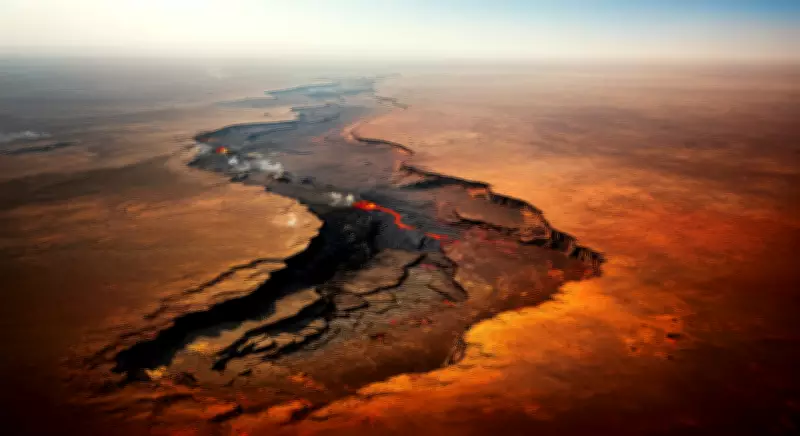
The Afar Depression in Eastern Africa is a region where the Earth's crust is slowly pulling apart, creating jagged valleys and shimmering salt flats. For years, scientists have observed the formation of a new ocean in this arid region. Recent research has revealed a massive network of magma beneath the surface, reshaping our understanding of how continents rift and oceanic crust forms.
Discovery of a Magma Network
A study published in Nature Communications in 2024 uncovered that the rifting process is driven by a complex network of magma structures called sills, which can span up to 100 kilometers. This network, extending over 60 miles, is comparable to the distance from Manhattan to eastern Connecticut. Instead of a single magma source, the region hosts a interconnected system of sills.
Satellite Data Reveals Hidden Structures
Geologists used space satellites to detect subtle ground movements, revealing that the entire valley is actively deforming. The data indicated four gigantic sills buried 9 to 28 kilometers beneath the Earth's crust, all expanding simultaneously. This suggests a deep energy source in the mantle continuously supplying magma through a network of channels.

How Oceans Form
This discovery overturns the traditional view of continental breakup, which was likened to snapping a tree branch. Instead, the process is more constructive: as the crust thins, magma fills the gaps, forming the foundation for a new ocean floor. A previous study in Nature Geoscience had shown the area contains a large magma reservoir formed by decompression melting. The 2024 findings go further, indicating that magmas travel along an organized regional network to create a new tectonic plate boundary.
Implications for Earth's Dynamics
The volcanic eruptions and rifting in the Afar Triangle are surface expressions of intense activity deep underground. This transformation takes millions of years, highlighting that while we go about our daily lives, the Earth beneath us is constantly reshaping itself.