

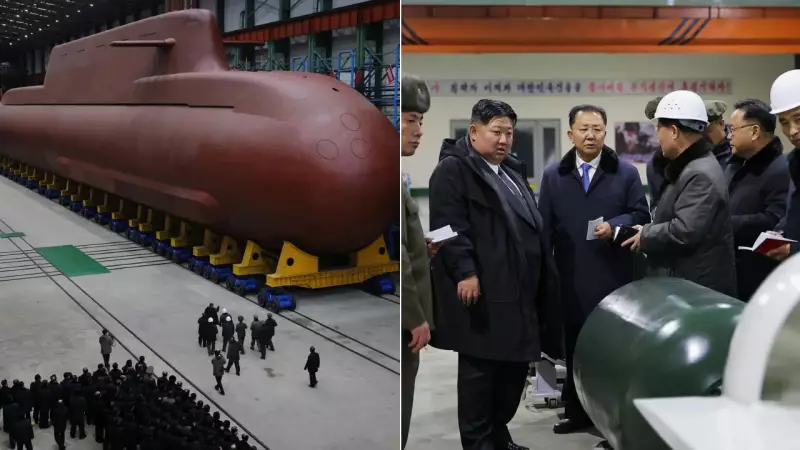
North Korea has taken a significant step in its advanced weapons development by publicly revealing the completed hull of what it claims is a nuclear-powered submarine. The move signals tangible progress on one of leader Kim Jong Un's top military priorities, even as Pyongyang lashed out at South Korea's own plans to acquire similar vessels, calling them a direct threat.
Kim Inspects Strategic Submarine Hull
State media released photographs on Thursday showing Kim Jong Un inspecting the welded hull of the "nuclear-powered strategic guided missile submarine" at a manufacturing facility. The development of such a submarine was designated as a critical project during a Workers' Party congress back in 2021. While North Korea has not announced a timeline for the vessel's completion or deployment, analysts say the unveiling of the hull itself is a major milestone.
"The completed and welded hull means that they have already mounted a nuclear reactor inside," explained Hong Min, a North Korean military expert at the Korea Institute for National Unification in Seoul. This development has long been questioned by analysts, who wondered how the isolated nation could master the complex technology required for a small, marine-based nuclear reactor.

Russian Assistance and Regional Tensions
The apparent speed of progress has fueled speculation that Pyongyang is receiving crucial technological assistance from Russia. This support is believed to be in return for North Korea's provision of troops and weapons to aid Moscow's war effort in Ukraine. South Korean and Western intelligence agencies estimate thousands of North Korean soldiers have been sent to Russia, with Seoul reporting around 2,000 fatalities.
Kim Jong Un explicitly condemned South Korea's ambitions to build nuclear-powered submarines, labelling them "an offensive act" and "a threat to its security that must be countered." He stated this compels North Korea to accelerate the "modernization and nuclear weaponization of the naval force." This reaction follows a November agreement where the United States pledged to help South Korea construct its first nuclear-powered submarine, though Seoul insists it will not arm them with nuclear weapons.
Adding to the tensions, Pyongyang this week criticised the port call of the US nuclear-powered attack submarine, USS Greeneville, in Busan, calling it an act that causes instability.
Missile Tests and Deepening Russia Ties
In a separate display of military advancement, North Korean media reported that Kim also oversaw the first test of a new high-altitude, long-range surface-to-air missile on Wednesday. The test reportedly involved missiles hitting mock targets at an altitude of 124 miles, which South Korea's military confirmed without providing details.
These developments coincide with a notable warming of relations between North Korea and Russia. The Korean Central News Agency reported that Kim received a message from Russian President Vladimir Putin praising their "invincible friendship." Putin specifically highlighted the "heroic" efforts of North Korean soldiers in Russia's Kursk region, a rare acknowledgment of their deployment. North Korea confirmed this month that some of its troops deployed in Kursk had died.
Analysts note that Kim's military push has gained considerable momentum since Russia's invasion of Ukraine, with Moscow likely providing fuel, food, and critical military technology in exchange for Pyongyang's support. This cooperation is seen as vital for modernising North Korea's ageing naval and air defence systems.
Looking ahead, North Korea is expected to hold a Workers' Party congress early next year, its most important political gathering. Kim Jong Un is likely to use the event to showcase these recent military advances and outline his policy goals for the coming five years, setting the stage for continued regional uncertainty.






