

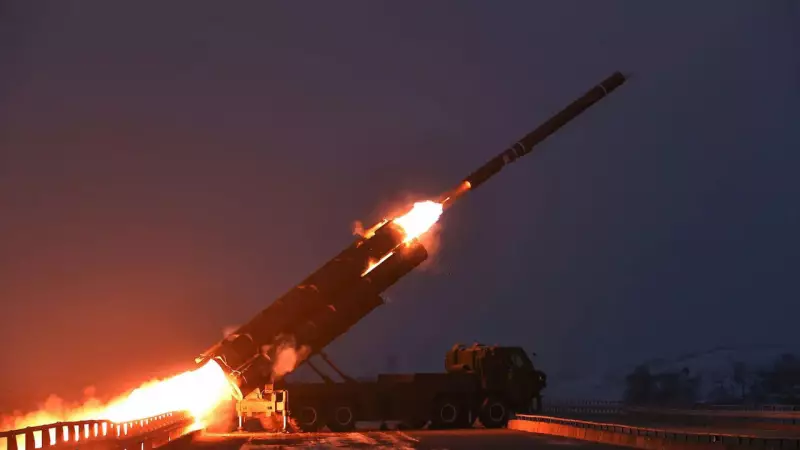
In a significant display of military power, North Korea has conducted a test launch of two strategic long-range cruise missiles. The move is seen as a direct demonstration of the country's nuclear combat readiness amid escalating tensions on the Korean Peninsula, fueled by increased military exercises by the United States and South Korea.
Kim Jong Un Oversees Strategic Drill
The missile launches took place on Sunday over the Yellow Sea, west of the Korean Peninsula. According to the state-run Korean Central News Agency (KCNA), the country's leader, Kim Jong Un, personally supervised the military exercise. The drill was designed to review the combat capability and counter-offensive readiness of the nation's long-range missile units.
State media reported that the missiles flew for more than two hours before successfully striking their designated targets in the sea. Accompanying videos released by KCNA showed the projectiles being launched and hitting their marks. Kim Jong Un expressed "great satisfaction" with the results and vowed to continue the "unlimited and sustained development" of North Korea's nuclear combat forces.

Regional Reactions and Strategic Implications
South Korea's Joint Chiefs of Staff confirmed detecting several cruise missile launches around 8:00 am on Sunday from the Sunan area near Pyongyang. The South Korean military stated it is maintaining full readiness in close coordination with the United States to counter any potential provocations from the North.
North Korea framed the test as a defensive measure. KCNA quoted Kim Jong Un, stating that verifying the reliability of the nation's nuclear deterrence was a "responsible exercise of the right to self-defence and war deterrence." This was positioned as a necessary response to what Pyongyang perceives as growing external security threats.
Analyst Yang Moo-jin, former president of the University of North Korean Studies in Seoul, noted the test was likely a direct counter to recent developments. He highlighted that the arrow-type cruise missiles, with an estimated range of 2,000 kilometres, could target locations across the Korean Peninsula and US military bases in Japan.
A Pattern of Provocation Amid Stalled Talks
This missile test follows closely on the heels of North Korea revealing progress on its first nuclear-powered submarine last week. Kim Jong Un, accompanied by senior officials and his daughter Kim Ju Ae, inspected the large submarine under construction. Pyongyang has suggested this vessel could be armed with nuclear-capable missiles.
The timing is also critical as North Korea prepares for a ruling Workers’ Party congress early next year, its first in five years. The international community will be watching to see if Kim outlines new policy directions, especially concerning the United States and long-stalled nuclear negotiations.
Tensions have been particularly high following South Korea's plans to build its own nuclear-powered submarine, which Kim labelled an "offensive act." Pyongyang has also strongly criticised the recent docking of the US Navy's nuclear-powered attack submarine USS Greenville at the South Korean port of Busan.
While United Nations Security Council resolutions prohibit North Korea from testing ballistic missiles, cruise missile tests are not explicitly banned. However, security experts warn that these low-flying, highly precise missiles pose a serious threat as they are harder for radar systems to detect.
The latest provocation underscores the deepening stalemate since nuclear talks with the United States collapsed in 2019. Although Kim Jong Un has recently signalled a willingness to return to negotiations, experts believe he is intent on using his expanding nuclear arsenal as leverage in any future dialogue with Washington.






