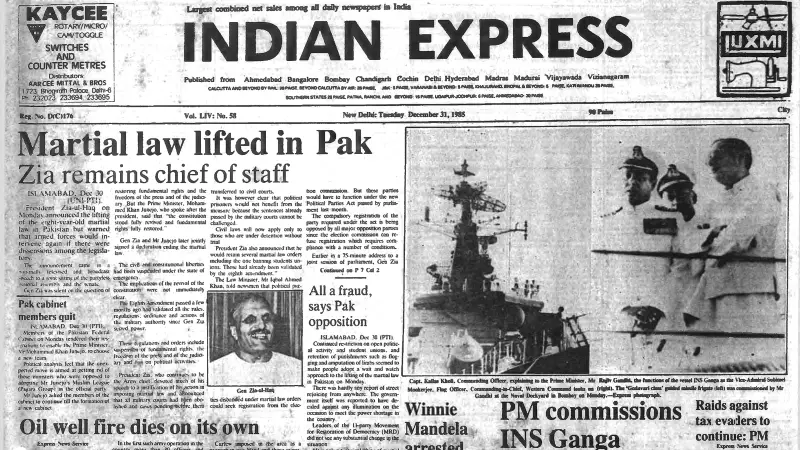
On a significant day in South Asian history, December 31, 1985, Pakistan's military ruler President General Zia-ul-Haq formally announced the end of an eight-year period of martial law. The declaration was made during a nationally televised address to a joint session of the country's partyless National Assembly and Senate.
A Conditional End to Military Rule
While announcing the lifting of martial law, President Zia issued a stern warning. He stated that the armed forces would not hesitate to intervene again if lawmakers fell into dissension. Notably, his speech remained silent on the crucial issues of restoring fundamental rights, press freedoms, and an independent judiciary, leaving the extent of the democratic transition in question.
In a related political development, the entire Pakistan Federal Cabinet submitted their resignations on that Monday. This move was seen as enabling the Prime Minister, Mohammed Khan Junejo, to form a new team. Political analysts of the time interpreted this unexpected step as an effort to remove ministers opposed to adopting Junejo's faction, the Muslim League (Pagara Group), as the official governing party.

Public Apathy and Opposition Skepticism
The lifting of martial law was met with a notably muted public response across Pakistan. There were hardly any reports of street celebrations or public rejoicing. The government itself reportedly decided against any official illuminations to mark the occasion, citing the severe power shortages plaguing the nation.
This public apathy was likely influenced by the continuation of several harsh restrictions. Open political activity and student unions remained banned, and brutal punishments like public flogging and amputation of limbs were still retained in the legal system. This led most citizens and observers to adopt a cautious, wait-and-watch approach towards the supposed normalization.
The main opposition alliance, the 11-party Movement for Restoration of Democracy (MRD), was quick to dismiss the move. Its leaders asserted that they saw no substantial change in the political situation on the ground, alleging the entire process was a facade.
International Ripples: The Rajneesh Fiji Controversy
In a separate but contemporaneous international development, the Fijian government made headlines regarding the controversial Indian spiritual leader Bhagwan Rajneesh. The Fiji Home Minister reportedly stated that Rajneesh would be denied entry into Fiji if Interpol or police agencies from countries where he had previously resided sent adverse reports about his group's activities.
Fiji authorities confirmed they were actively inquiring about the exact location where the "controversial bhagwan" planned to relocate, highlighting the global scrutiny his movement faced.
This snapshot of December 31, 1985, captured on the front page of The Indian Express, reveals a pivotal yet cautious moment in Pakistan's journey from direct military rule, overshadowed by conditions, skepticism, and the enduring power of the army establishment.