The Enigmatic Seabed Circles of Southern Japan
For decades, divers exploring the waters near Amami Oshima Island in southern Japan have encountered a peculiar phenomenon on the ocean floor. Since the 1990s, they have observed large, perfectly circular patterns etched into the sandy seabed at depths of approximately 25 meters. These structures, measuring up to two meters in diameter, feature intricate ridges and grooves radiating from a smooth central area, creating an appearance so precise that they seemed almost artificial or decorative.
A Marine Mystery That Baffled Experts
Initially dubbed "mystery circles" by the diving community, these formations would appear fully formed and then gradually fade away as ocean currents smoothed the sand over time. For years, no one witnessed their creation, and conventional explanations fell short. Ocean currents alone could not account for such symmetrical patterns, and geological processes seemed inadequate to explain their temporary, recurring nature. The circles remained an unsolved puzzle, sparking curiosity but yielding few answers despite their annual appearance and disappearance.
The Surprising Builder Revealed
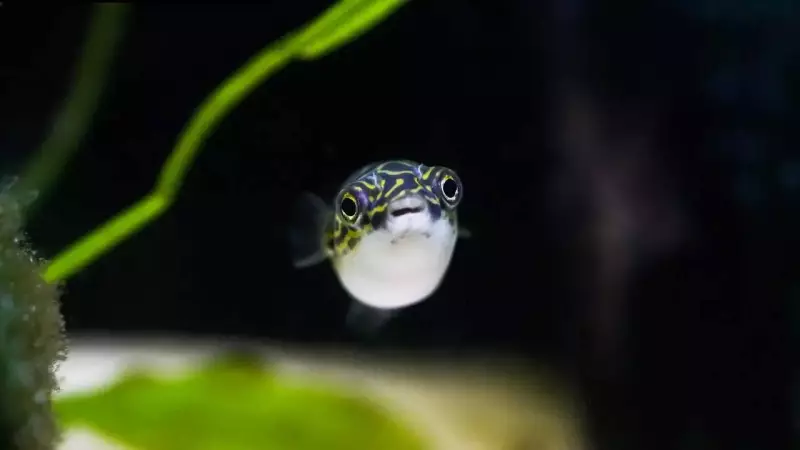
In 2011, through careful and persistent observation, researchers finally identified the architect behind these seabed circles: a small male pufferfish from the genus Torquigener. Measuring only about ten centimeters in length, this unassuming fish creates these massive structures with remarkable precision, using its fins to shape sand grain by grain. This discovery, supported by research published over the past decade, transformed the circles from mere curiosities into evidence of complex animal behavior, effort, and reproductive strategy.

The Intricate Construction Process
The male pufferfish dedicates approximately one week to building each nest. It begins by marking out a rough circular area, swimming back and forth to dig shallow valleys that form the characteristic ridges and grooves, arranged like spokes from the center. As construction progresses, the fish focuses on flattening the central zone and collecting fine sand particles. In the final stage, it decorates the ridges with shell fragments and coral pieces gathered from the surrounding area, adding a decorative touch to the functional structure.
Purpose and Function of the Pufferfish Nests
These elaborate nests play a crucial role in the mating rituals of the pufferfish. Females only approach when the structure is complete, at which point the male stirs fine sand into the water to create a visual display. Eggs are laid in the calm central area, where studies suggest the nest's shape helps gather fine particles and reduces water flow by over 20%, providing a stable environment for egg development. This dual function—serving as both a signal to attract mates and a functional shelter for offspring—highlights the nest's importance in reproduction.
Lifecycle and Abandonment of the Nests
After spawning, the male guards the eggs for several days but does not maintain the nest structure. Ocean currents gradually flatten the ridges and wash away the fine sand, and once the eggs hatch, the male leaves permanently. Instead of repairing the old nest, it builds a new one elsewhere, as researchers believe the loss of fine sand makes reuse inefficient. This cycle of construction, use, and abandonment repeats continuously, with the circles appearing and disappearing on the seabed while the ocean above remains seemingly unchanged.
Scientific Significance and Broader Implications
The discovery of the pufferfish circles adds significant evidence that sexual selection can drive complex construction behavior in marine species. While such traits are well-documented in birds and insects, fewer examples exist underwater. The nests demonstrate how animals can create elaborate structures at a high cost, abandoned quickly after use, yet repeated in a relentless reproductive cycle. Fluid experiments with scaled models have confirmed that the nest's design effectively slows water flow in the central area, protecting eggs and explaining why fine sand accumulates there rather than being swept away.

This finding not only solves a long-standing marine mystery but also enriches our understanding of animal behavior, adaptation, and the intricate ways life thrives in ocean ecosystems. It underscores how even small, seemingly ordinary creatures can exhibit extraordinary capabilities, reshaping our perception of the natural world beneath the waves.