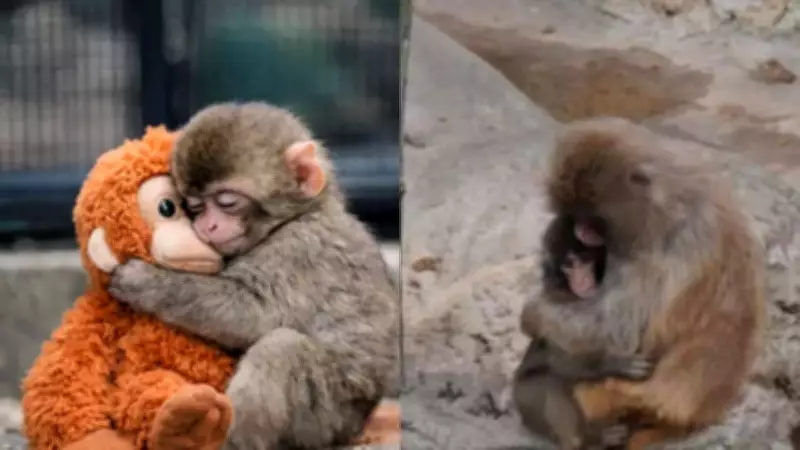
The Lonely Macaque Who United the World in Empathy
One moment, he is being swatted away by another monkey. The next, he is curled up in a quiet, desperate hug with a soft plush toy. Regardless of the scene, Punch—a baby Japanese macaque at Ichikawa City Zoo near Tokyo—possesses an uncanny ability to leave thousands of humans teary-eyed, mourning his palpable loneliness from behind glowing phone screens worldwide.
From Maternal Rejection to Global Emotional Anchor
Born in July 2025 and quickly rejected by his mother, Punch faced a devastating start. In Japanese macaque society, survival hinges critically on maternal bonding and social learning, both requiring a female caregiver. Hand-raised by dedicated zoo keepers, he found solace in an unlikely source: an IKEA plush orangutan toy, affectionately nicknamed "Ora-mama." This soft-textured companion became his emotional anchor, a substitute for the warmth he was denied.
Introduced to the zoo's 'Monkey Mountain' in January, Punch attempted to bond with his troop, only to face repeated rejection and bullying. Viral videos captured his heartbreaking retreats to his plushie mom or his anxious waits for zookeepers to arrive, seeking physical comfort. These moments transformed him from just another vulnerable animal into a global emotional phenomenon, where no update—a hug, a step forward, a moment of play—feels small. Each becomes a significant event for an audience refreshing feeds in search of hope.

The Neuroscience Behind the Obsession
Why does Punch exert such an extraordinary hold on the human heart? Morten Kringelbach, Professor of Neuroscience at Linacre College and the Department of Psychiatry, University of Oxford, explains the brain's response. According to Professor Kringelbach, Punch resembles a baby, triggering the emotional part of the brain known as the orbitofrontal cortex within a seventh of a second—before conscious awareness kicks in. This rapid activation compels humans to react with an instinctive "aww."
Opening oneself to feelings of cuteness also unlocks broader empathy and compassion. "The reason we find Punch's story heartwarming is that it reminds us what it truly means to be human: to care for others. Seeing this in animals deeply touches our heartstrings," the professor noted in a video shared by the University of Oxford.
The orbitofrontal cortex is crucial in representing expected reward value, outcome reward value, non-reward, and punishment, making it central to human emotion and emotional disorders. For humans wired to empathize with infants and the helpless, Punch becomes an ideal recipient for warmth and love. This response is heavily shaped by emotional bonding, parental instincts, and the tendency to humanize and personalize events, fueling the obsession for a happy ending.
The Human Craving for Happy Endings and Personal Connection
Happiness is a welcome emotion, especially following struggle and sadness. Martin Vestergaard, a cognitive and behavioural neuroscientist at Cambridge University, observes, "It turns out that people want happy endings." This desire aligns with findings from behavioural economists George Loewenstein and Drazen Prelec, who in a 1993 paper suggested humans prefer improving trends in experiences, reveling in the anticipation of positive outcomes.
Punch's story feels intensely personal due to the human mind's pattern of personalization. Humans perceive the world as happening to them, internalizing events—words, actions, developments, problems—and magnifying their roles. Punch's experiences of rejection, isolation, and loneliness resonate because viewers see reflections of their own emotions: rejection by family, scolding by a boss, or separation from friends. This internalization explains why the $19.99 IKEA plushie sold out in numerous countries and why offers to adopt Punch poured in, including a $250,000 bid from Tristan Tate and a $50,000 offer from activist Ryan Fournier.

A Symbol of Hope in a Digital Age
Despite the impossibility of adoption, people continue to cling to every video of Punch that surfaces online—whether he is receiving a hug, being protected, or playing with a stick. His journey symbolizes more than an animal's plight; it represents a collective yearning for acceptance and happiness. As viewers hold hope for Punch's eventual acceptance, they secretly nurture hope for their own, making his story a poignant testament to the power of empathy in connecting humanity across screens and species.