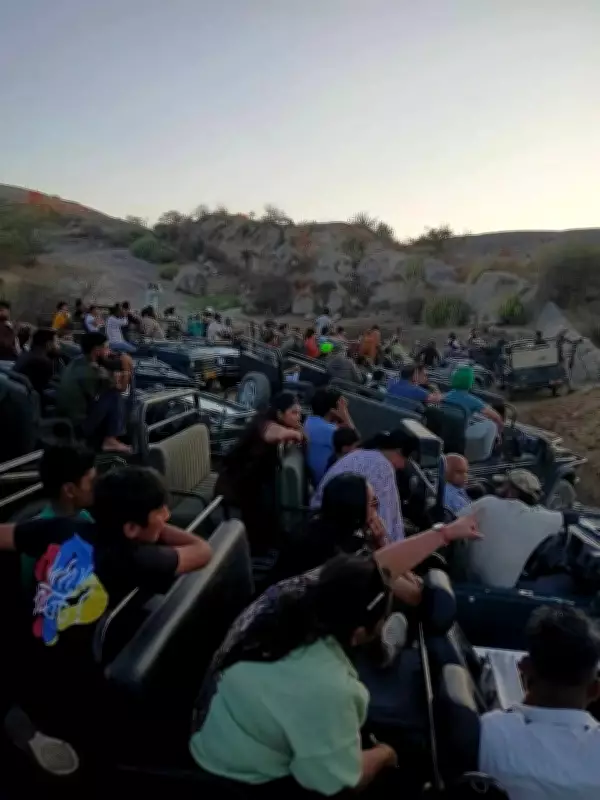
The Rajasthan forest department has drafted a Standard Operating Procedure (SOP) to regulate safari and eco-tourism activities in the Jawai leopard landscape, following growing concerns over unregulated tourism, wildlife disturbance, and habitat degradation. The SOP, framed on the directions of the high court, aims to balance wildlife conservation with local livelihoods linked to tourism.
Need for Regulation
Chief Conservator of Forests, Jodhpur, Anoop K.R. stated that the increasing tourism footprint in the region made regulation necessary. "The ecologically sensitive Jawai landscape required a structured framework due to its growing tourism footprint and high leopard visibility. So the SOP has been prepared to regulate tourism in the region on the direction of the court," he said.
Key Provisions of the SOP
Under the proposed framework, only vehicles registered with the Jawai Safari & Eco Tourism Coordination Committee (JSECC) will be allowed to conduct safaris. The SOP also makes GPS monitoring compulsory for all registered safari vehicles to strengthen surveillance and enforcement. "All registered safari vehicles will be required to install GPS tracking devices approved by the forest department," the SOP stated. Officials said the GPS system will help monitor vehicle movement, identify entry into restricted areas, assess crowding near wildlife habitats, and improve transparency in enforcement.

Prohibited Activities and Penalties
The draft identifies several activities as serious violations, including night safaris, wildlife baiting, unauthorised entry into sensitive habitats, drone use near leopard caves, deliberate crowding around wildlife, blocking animal movement, repeated noise disturbance, and use of sound playback to provoke animals. "Penalties may include immediate termination of safari activity, suspension of JSECC registration, temporary bans, blacklisting of vehicles, and fines of Rs 25,000 in cases where provisions of the Wildlife Protection Act are not invoked," an official said. Forest officials ranging from deputy conservator of forests to field staff and forest guards will be authorised to enforce the SOP.
Implementation and Coordination
The proposal also envisages formation of the JSECC under the chairmanship of the Pali district collector, with representation from the forest, police, tourism, and transport departments, local bodies, safari operators, and resort owners. The committee will function as a coordination and advisory body without independent enforcement powers. The deputy conservator of forests, Pali Forest Division, has been proposed as the nodal authority for implementation and inter-departmental coordination.
Protection of Leopard Habitats
The SOP further proposed mapping and categorisation of leopard caves and sensitive habitats into breeding or maternal caves, high-use resting caves, and occasional-use caves based on field observations and camera trap evidence. It recommends special protection measures around breeding and high-use caves, including restrictions on vehicle crowding and prolonged parking near viewing spots. Recognising the ecological sensitivity of the region, the SOP prescribes a minimum distance of 30 metres from identified leopard caves for safari vehicles unless a larger buffer is notified. Vehicles will not be allowed to block cave entrances, obstruct exit routes, or force close encounters with wildlife.
Area of Application
The proposed SOP will apply across Jawaibandh Leopard Conservation Reserve I and II and adjoining villages including Bera, Doodni, Sena, Jeevda, Velar, Kothar, Raghunathpura, Varaval, Bisalpur, and Mori, covering forest, revenue, private, and community grazing lands.