

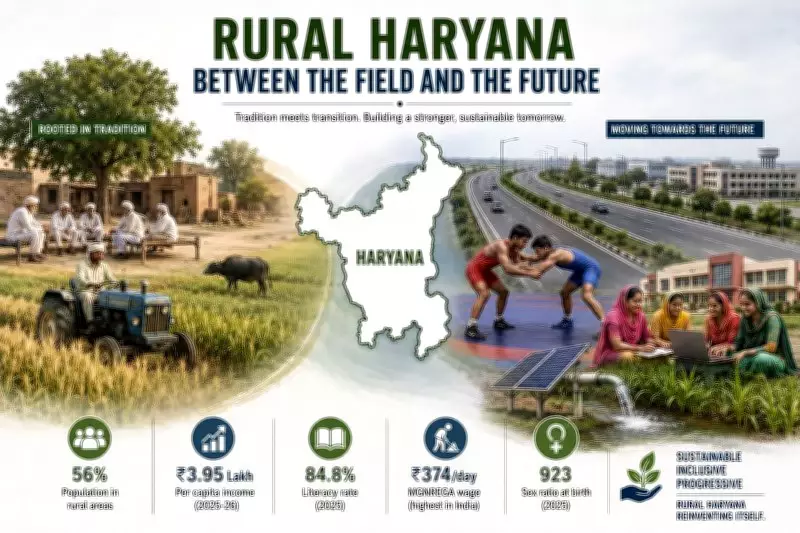
The conventional image of rural Haryana has long been defined by vast wheat fields, livestock, agrarian communities and the social world of the village chaupal. Today, that image is undergoing a profound transformation. Rural Haryana increasingly stands at the intersection of agricultural traditions, urban expansion and evolving economic aspirations.
More than 56 per cent of Haryana's population continues to live in rural areas. Simultaneously, the state's per capita income has risen from around Rs 1.47 lakh in 2014-15 to nearly Rs 3.95 lakh in 2025-26, while the Gross State Domestic Product (GSDP) is estimated at approximately Rs 13.7 lakh crore, registering an annual growth rate of 11.8 per cent. Beneath these impressive economic indicators, however, lies a more complex story. Rural Haryana today reflects multiple transitions unfolding across its economy, society and culture.
Rural Haryana: India's Sporting Nursery
Sport has emerged as one of the most visible markers of rural Haryana's transformation. Wrestling, boxing, kabaddi and athletics have become powerful avenues of social mobility and aspiration. Despite accounting for only around 2 per cent of India's population, Haryana has consistently produced a remarkable number of elite athletes.

Sportspersons such as Neeraj Chopra, Sakshi Malik, Vinesh Phogat and Ravi Dahiya, all hailing from rural backgrounds, have become symbols of achievement and inspiration. For many rural households, sport is increasingly viewed as a pathway to employment, recognition and upward mobility. Traditional akharas now coexist with modern academies and organised training infrastructure, reflecting the convergence of local traditions and professional opportunities.
Women and the Changing Social Landscape
The transformation of rural Haryana is also evident in shifting gender dynamics. Women's participation in self-help groups (SHGs), entrepreneurship, sports and local governance institutions has expanded beyond traditional boundaries. More than 58,000 SHGs have been formed under various livelihood programmes, supported by substantial banking linkages.
Social indicators present a mixed picture. Literacy has improved to nearly 84.8 per cent, while the sex ratio at birth has recovered to 923 in 2025 after years of decline. However, challenges related to workforce participation, wage disparities and gender inequality continue to persist, underscoring the unfinished nature of social transformation.
Prosperity and the Paradox of Rural Labour
Economic growth has not always translated into employment security. Despite being among India's more prosperous states, Haryana continues to report one of the country's highest unemployment rates. This contradiction highlights a striking paradox: rising prosperity and labour insecurity coexist within the same development landscape.
The Covid-19 pandemic exposed vulnerabilities in rural labour markets. Demand under the Mahatma Gandhi National Rural Employment Guarantee Act (MGNREGA) reached unprecedented levels before stabilising at over 96 lakh person-days. Haryana also offers the country's highest MGNREGA wage at Rs 374 per day. The experience demonstrated that high income growth alone does not guarantee sustainable livelihood security.
Agriculture at an Ecological Crossroads
Agriculture remains the backbone of Haryana's rural economy. The state contributes nearly 60 per cent of India's basmati rice exports and around 7 per cent of the country's total agricultural exports.
Yet this success increasingly carries ecological costs. The wheat-paddy production cycle, supported by assured procurement and Minimum Support Price (MSP) mechanisms, has generated stable incomes for farmers. However, the dominance of water-intensive crops has accelerated groundwater depletion and constrained crop diversification.
The challenge facing Haryana is no longer limited to increasing agricultural productivity. It is equally about ensuring long-term environmental sustainability and resource conservation.
Between the Village and the Highway
Infrastructure development is rapidly reshaping rural geography. The 227-km Trans Haryana Expressway, connecting Ambala and Narnaul, has transformed patterns of connectivity, trade and mobility across large rural regions.

As National Capital Region (NCR)-driven urbanisation extends deeper into the countryside, many villages are gradually evolving into peri-urban spaces. Agriculture is no longer the sole source of livelihood or identity. Land increasingly functions as an economic asset linked to logistics, transport networks, warehousing and real estate development.
Khaps and the Negotiation Between Tradition and Modernity
Traditionally associated with customary authority, khap institutions continue to influence rural Haryana's social fabric. Their contemporary role reflects both continuity and adaptation. Khaps have participated in farmer movements, community welfare initiatives and social campaigns, while also remaining at the centre of debates concerning gender equality, individual freedoms and constitutional values.
Their evolution mirrors the broader negotiation between tradition and modernity unfolding across rural Haryana.
Education and Emerging Aspirations
Education is undergoing a significant structural transition. Haryana is increasingly shifting its focus from expanding school access to improving learning outcomes under the National Education Policy framework.
The state has allocated more than Rs 22,900 crore for education in 2026-27. Literacy has improved from 75.6 per cent in 2011 to nearly 84.8 per cent. Rising educational attainment is gradually reshaping aspirations, employment choices and social mobility across rural communities.
The Geography of Uneven Development
The transformation of rural Haryana has not been uniform. Regions linked to the NCR have benefited disproportionately from infrastructure investments, market access and economic opportunities. In contrast, districts such as Nuh continue to face structural disadvantages in literacy, educational outcomes and broader human development indicators.
This uneven pattern of development raises an important governance challenge: can Haryana sustain its growth trajectory without ensuring balanced regional development?
Reinventing Rural Haryana
The challenge before policymakers is not merely to accelerate growth but to ensure that transformation remains inclusive, sustainable and regionally balanced.
Initiatives such as Mera Pani Meri Virasat, the Pradhan Mantri Krishi Sinchayee Yojana, Smart Agriculture Clusters and solar-powered irrigation systems can support sustainable agricultural practices. Likewise, programmes such as the Deen Dayal Upadhyaya Grameen Kaushalya Yojana, the National Rural Livelihood Mission and the Lakhpati Didi initiative can strengthen skill development, entrepreneurship and women-led livelihoods.
Ultimately, rural transformation requires a governance framework that balances economic growth with environmental sustainability and social inclusion. Rural Haryana is not witnessing the disappearance of village life. Rather, it is witnessing its reinvention positioned between the field and the future.





