

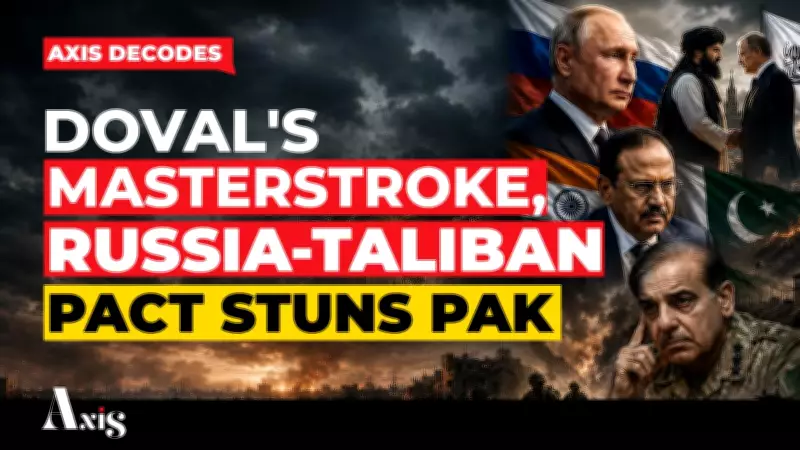
Russia has signed a military-technical cooperation pact with the Taliban, becoming the first major global power to formally recognize and engage militarily with Afghanistan's ruling regime. The landmark agreement was announced on June 1, 2026, and has sent shockwaves through the geopolitical landscape of South Asia.
Doval's Moscow Diplomacy
The development coincided with Indian National Security Adviser Ajit Doval's high-level meetings in Moscow, where discussions centered on defense cooperation, maritime security, and strategic partnership. The timing of these parallel events has sparked intense debate among analysts, who see a rapidly evolving Eurasian security architecture.
Russia's Strategic Shift
Moscow's decision to formalize ties with the Taliban marks a significant departure from its previous stance. The pact includes provisions for military-technical exchanges, signaling Russia's intent to play a larger role in Afghanistan's stability and counterterrorism efforts. This move also challenges the influence of other regional powers, including the United States and China.

Pakistan's Two-Front Headache
Pakistan, once considered the Taliban's closest ally, now finds itself in a precarious position. Months of border clashes and military exchanges with Kabul have turned the western frontier into a hostile zone. The Russia-Taliban pact further isolates Islamabad, which faces a potential two-front challenge: an unfriendly Afghanistan to the west and a historically tense relationship with India to the east.
Implications for India
For India, the situation presents both opportunities and dilemmas. New Delhi has maintained growing engagement with both Moscow and Kabul, but it stops short of formally recognizing the Taliban. Doval's visit underscores India's desire to leverage this opening without compromising its principles. Analysts suggest that India could benefit from Russia's increased presence in Afghanistan, particularly in countering Pakistan-backed terrorism and securing energy routes.
Regional Balance Shifting
The strategic balance in South Asia is undeniably shifting. As Russia opens a new channel with the Taliban, and India deepens its ties with both Moscow and Kabul, the traditional power dynamics are being redrawn. Pakistani military planners are increasingly concerned about a hostile western frontier, which could stretch their resources thin.
What Lies Ahead?
Questions abound: Is a new Eurasian security architecture emerging? Can India navigate this complex terrain without formally aligning with the Taliban? And will Pakistan be forced to recalibrate its foreign policy? The coming months will be critical as these developments unfold, potentially reshaping the region for years to come.






