

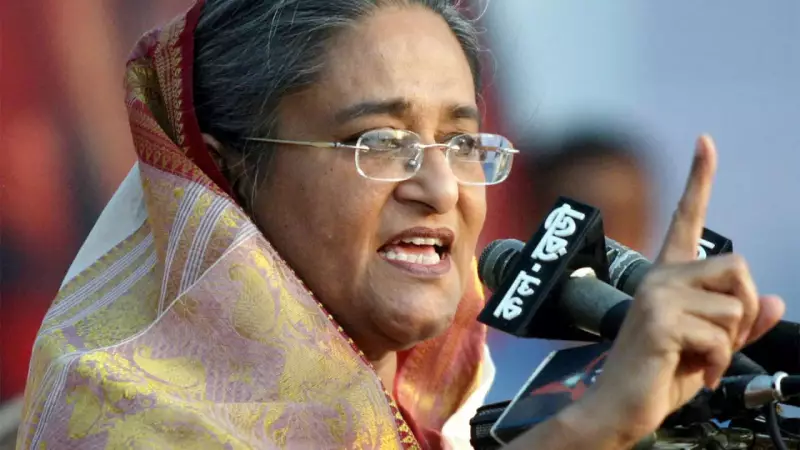
Former Bangladesh Prime Minister Sheikh Hasina has firmly rejected calls for her to return to the country, labelling the legal proceedings against her as a politically motivated attempt at assassination. Her strong comments come amidst fresh unrest in Bangladesh, including the tragic killing of a Hindu man last week.
Hasina's Defiant Stance on Return and Tribunal Verdict
In a clear and defiant message, Sheikh Hasina stated that she cannot be forced to return to face what she terms her "political assassination." She made these remarks on Monday, addressing the ongoing legal actions against her. Hasina revealed she has challenged Chief Adviser Muhammad Yunus to take the matter to the International Court of Justice in The Hague, expressing full confidence that an independent court would find her not guilty.
She set clear conditions for her return, stating she would only go back when Bangladesh has a legitimate government and an independent judiciary. Elaborating via an email interview with ANI, Hasina described the verdict delivered by the International Crimes Tribunal (ICT) as not a judicial exercise but a political one. She powerfully termed it a "political assassination in judicial robes."

Hasina alleged she was denied the fundamental right to defend herself and to appoint lawyers of her choice. She accused the tribunal of being used to conduct a "witch hunt of Awami League," her political party. This follows a November ruling by a Bangladesh court which found Hasina guilty of "crimes against humanity" in connection with the July-August 2024 uprising. Local media, including the Dhaka Tribune, reported that ICT-1 imposed the death penalty, convicting the former Prime Minister on all five charges.
Attacks on Interim Govt and Election Credibility
Against this backdrop of legal action and recent violence, Sheikh Hasina launched a sharp critique of the interim administration. She accused the government headed by Chief Adviser Muhammad Yunus of "lacking democratic legitimacy" and driving the nation toward instability. Hasina claimed this is being done by weakening state institutions and empowering extremist elements.
She also raised serious questions about the credibility of the elections scheduled for February 2016, citing the continued ban on her party, the Awami League. "An election without Awami League is not an election, but a coronation," she asserted. Hasina alleged that Yunus is governing "without a single vote from Bangladeshi people" while simultaneously trying to bar a party that has won nine national mandates.
She warned that any administration formed under such circumstances would lack moral authority and would waste a crucial opportunity for genuine national reconciliation.
Concerns Over Extremism and Explanation for Exit
Explaining her decision to leave Bangladesh, Sheikh Hasina stated that she departed to prevent further bloodshed and not because she feared being held accountable. She emphasised that her trust in Bangladesh's constitutional framework remains intact. "Our constitutional tradition is strong, and when legitimate governance is restored and our judiciary regains its independence, justice will prevail," she affirmed.
In a significant part of her interview, Hasina expressed deep concerns about the growing influence of radical Islamist groups in the country. She made the serious allegation that Chief Adviser Yunus has appointed extremists to cabinet positions, released convicted terrorists, and allowed organisations linked to international terror networks to operate openly in public life.
The situation presents a complex picture of political strife, legal controversy, and security concerns in Bangladesh, with the former Prime Minister positioning herself as a figure fighting against what she sees as an illegitimate and dangerous regime.






