

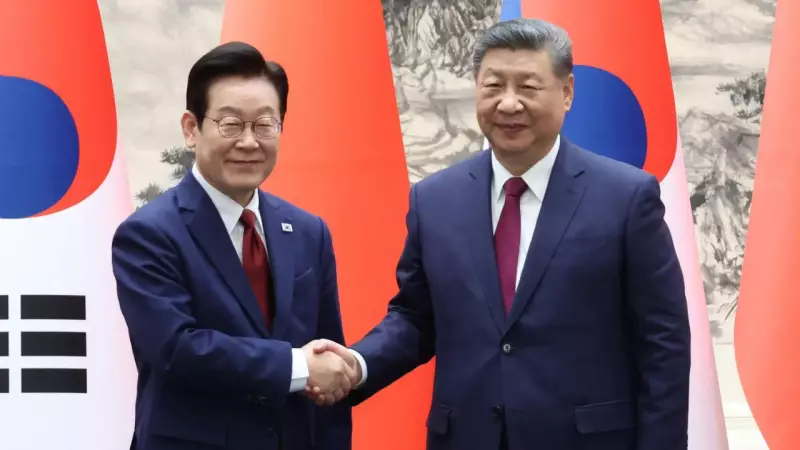
In a significant diplomatic move, South Korean President Lee Jae Myung has publicly revealed that he formally requested Chinese President Xi Jinping to act as a mediator to resolve the escalating North Korean nuclear crisis and ease tensions on the Korean Peninsula. The request was made during a summit between the two leaders in Beijing on Monday, as South Korea faces a complete communication blackout with its northern neighbour.
Direct Appeal for Chinese Mediation
Speaking to reporters in Shanghai on Wednesday, President Lee provided details of his high-stakes conversation with the Chinese leader. He confirmed that he explicitly asked President Xi Jinping for China to play a constructive role in facilitating peace. "I told him it would be good for China to play the role of a mediator for peace," Lee stated, according to his televised comments. He emphasised the severity of the communication breakdown, noting that all official channels with Pyongyang are currently blocked, making direct dialogue impossible.
The South Korean leader's appeal underscores the growing frustration in Seoul over the stalled diplomatic process. China, being North Korea's largest trading partner and most important diplomatic ally, is viewed as the only nation with sufficient influence to potentially bring Pyongyang back to the negotiating table. The United States and South Korea have repeatedly urged Beijing to leverage this unique position.

China's Call for Patience and a Proposed First Step
In response to Lee's request, President Xi Jinping stressed the need for patience regarding North Korean issues, a message that was later echoed by Chinese Premier Li Qiang during a separate meeting with Lee on Tuesday. Despite the call for restraint, President Lee outlined a potential path forward during his discussions.
He urged China to help curb Pyongyang's advancing nuclear programme and suggested that a freeze on further development of nuclear weapons and missiles could serve as a feasible first step, provided the right conditions are met. Lee reported that China shared his view on the importance of freezing North Korea's programmes to prevent further expansion of its arsenal. "Leaving the current status would be a loss for Northeast Asia and the entire world," Lee warned, highlighting the continuous production of nuclear weapons by North Korea.
Stalled Diplomacy and Regional Implications
The diplomatic outreach comes at a time when North Korea has firmly refused to resume dialogue with either South Korea or the United States. Pyongyang has also declared that denuclearisation is off the negotiating table indefinitely, presenting a major obstacle to any peace process.
While China has historically called for restraint, it has also blocked tougher United Nations sanctions in recent years despite a series of North Korean weapons tests. This stance has often put Beijing at odds with Seoul and Washington. Experts caution that any strategy offering incentives for limited steps, such as a freeze, risks allowing North Korea to retain the bulk of its dangerous nuclear programme while gaining concessions.
President Lee's direct public revelation of the mediation request signals Seoul's urgent search for alternative diplomatic avenues. The world now watches to see if China will transition from its traditional role of a protector to an active peace broker in one of the globe's most volatile standoffs.






