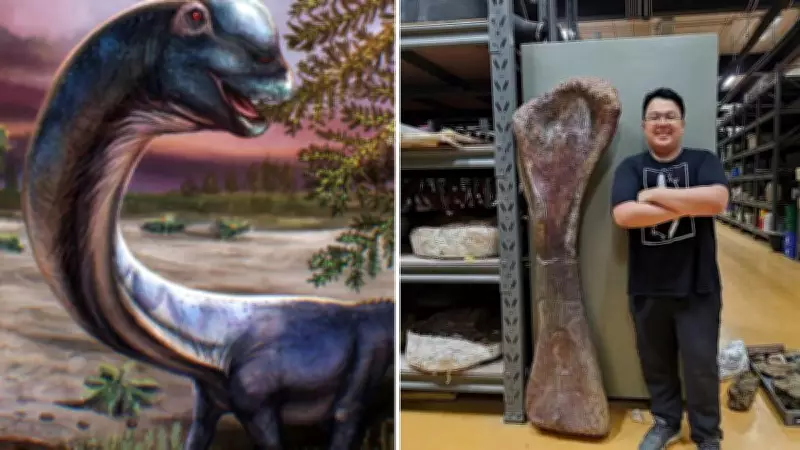
Scientists have uncovered the remains of the largest dinosaur ever found in Southeast Asia, a colossal creature that roamed the Earth approximately 113 million years ago. The newly discovered species, named Nagatitan, was hidden beneath the soil of Thailand for millennia, offering new insights into the prehistoric world.
A Giant from the Cretaceous Period
Nagatitan lived during the Cretaceous period, a time when Earth's atmospheric carbon dioxide levels were significantly higher than today, leading to elevated global temperatures. These conditions allowed massive reptiles like Nagatitan to thrive. The dinosaur belongs to the sauropod group, known for their long necks and tails, and is estimated to have been one of the largest land animals to have ever existed in the region.
Discovery and Significance
The fossilized bones were unearthed in the Khorat Plateau of northeastern Thailand, an area rich in dinosaur fossils. Researchers from Thailand and Japan collaborated on the excavation and analysis. The discovery is significant not only for its size but also because it fills a gap in the understanding of dinosaur evolution in Southeast Asia. Nagatitan is believed to have been a herbivore, feeding on the abundant vegetation of its time.

- The dinosaur's name combines "Naga," a mythical serpent from Southeast Asian folklore, with "titan," reflecting its immense size.
- The fossils include vertebrae, ribs, and limb bones, allowing scientists to estimate its length at over 30 meters.
- This find highlights Thailand's potential for further paleontological discoveries.
Implications for Climate and Evolution
The high carbon dioxide levels during the Cretaceous period created a greenhouse climate, which supported lush forests and large herbivores. Studying Nagatitan helps scientists understand how life adapted to such conditions. The discovery also underscores the importance of ongoing research in Southeast Asia, which is less explored compared to other fossil-rich regions.
Further studies are planned to analyze the bone microstructure and reconstruct the dinosaur's growth patterns. The fossils will be housed at the Sirindhorn Museum in Kalasin province, where they will be available for public viewing and scientific research.