

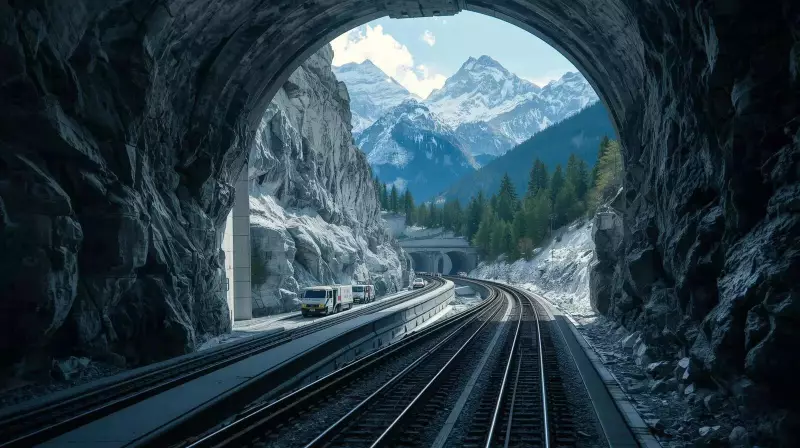
Switzerland's Hidden World: The Massive Tunnel Network Beneath the Alps
People often describe Switzerland by what they see above ground. Majestic mountains, scenic passes, crystal-clear lakes and efficient rail lines dominate the picture. But there is another world hidden from view. For decades, Switzerland has poured enormous resources into building tunnels that move people, goods, water and power through its challenging landscape.
A Network Shaped by Geography and Need
This massive undertaking did not follow a single master plan. It evolved gradually over time. Geography, postwar reconstruction efforts, and growing pressure on transport networks all played their part. Today, Switzerland boasts thousands of tunnels stretching for thousands of kilometres. Some are short local passages. Others are engineering marvels that run for tens of kilometres through solid rock. Together, they form a critical system that supports daily life while remaining largely invisible.
The mountainous terrain left little choice for engineers. Much of the country features sharp changes in elevation over very short distances. Constructing roads or railways on the surface proved slow, expensive, and often highly disruptive. Tunnels offered a practical solution. They provide a way through without constant exposure to harsh weather, steep gradients, or unstable slopes.

High mobility levels also drove the need. Switzerland experiences intense daily travel, both within its borders and across them. The public expects infrastructure to work reliably and to reach even the most remote areas. Over time, tunnelling became a standard response rather than an exceptional engineering feat.
The Scale of the Underground Network
According to the Swiss Tunnelling Society, the country has constructed approximately 1,852 tunnels. Their combined length reaches about 2,544 kilometres. This includes road tunnels, railway tunnels, and older structures linked to water and power systems. The sheer scale is difficult to grasp from the surface. In terms of length alone, this underground network rivals major urban metro systems around the world. In some Swiss regions, a significant portion of all travel now happens underground.
Highways Beneath the Surface
Switzerland's highway network ranks among the densest globally. Around 1,840 kilometres of national highways are currently in operation. About 250 tunnels form part of this network. When all planned sections are finished, the total length should reach nearly 1,893 kilometres. This will include more than 270 tunnels spanning roughly 290 kilometres.
Many highways run through tunnels to limit noise pollution, reduce land use, or pass discreetly beneath towns and villages. At least three-quarters of the network consists of four-lane divided roads. A large number of these carry substantial international traffic.
The Post-War Tunnel Boom
The major expansion began after the Second World War. From around 1950, Switzerland launched large-scale drainage tunnelling projects for hydroelectric power generation. Road tunnel construction followed in the 1980s. Railway tunnels became the primary focus from approximately the year 2000 onward.
Today, more than ten percent of both the motorway and railway networks run underground. Experts consider this proportion a global record. Around 50 railway tunnels and 55 road tunnels exceed two kilometres in length. Their total combined length continues to grow with new projects.
The Iconic Gotthard Base Tunnel
The Gotthard Base Tunnel stands as the ultimate symbol of this engineering philosophy. Opened in June 2016, it stretches for 57 kilometres, making it the longest tunnel in the world. It allows trains to cross the Alps at a much lower altitude. This design drastically reduces travel time and energy consumption. While it is the most famous example, it is part of a broader pattern. Long base tunnels now form the backbone of Swiss rail transport, actively shifting freight and passenger traffic from roads to more efficient railways.
Not Just the High Alps
Recent construction work has expanded beyond the high mountains. The Central Plateau has become a major focus due to increasing congestion and urban growth. Plans include a massive 30-kilometre railway tunnel between Zurich and Rupperswil. This project aims to ease a critical national bottleneck.

Other significant projects around Zurich include the Brüttener tunnel and a second Zimmerberg tunnel. Road projects also increasingly favour underground routes. This is especially true in cities like Basel, Lucerne, Berne and St Gallen, where surface space is limited.
What Lies Beneath Major Cities
Major Swiss cities are developing entire tunnel systems around their main railway stations. Zurich opened a new underground station in 2015 specifically to handle growing east-west traffic. Further underground expansions are actively planned in Basel, Berne, Geneva and Lucerne.
These subterranean spaces are functional rather than grand. They consist of platforms, service corridors, ventilation shafts and emergency routes. This quiet layer beneath the streets is designed to cope with immense daily pressure. Once their job is done, they simply fade back into the routine, unseen but absolutely essential to the nation's smooth operation.





