

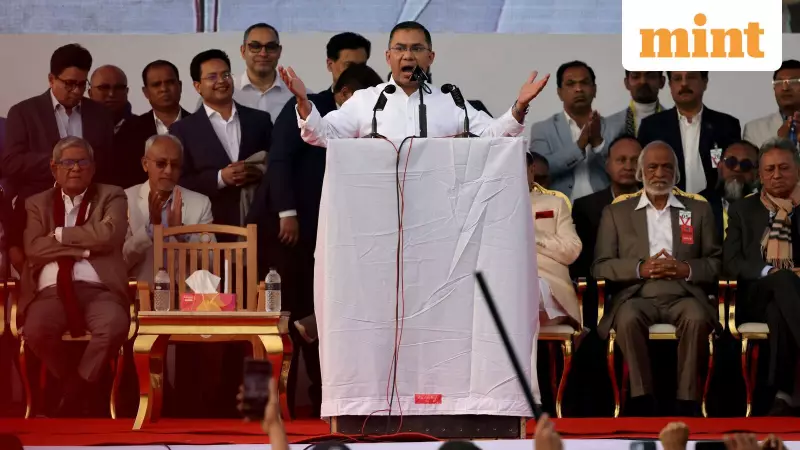
In a dramatic political homecoming, Tarique Rahman, the acting chairman of the Bangladesh Nationalist Party (BNP), returned to Dhaka on Thursday, concluding a 17-year exile spent primarily in London. His return strategically precedes the crucial parliamentary elections scheduled for February 2026, where his party is now considered the primary contender following the disqualification of the incumbent Awami League.
The End of a Long Exile and a Path to Power
Tarique Rahman's arrival at Hazrat Shahjalal International Airport marks a pivotal moment in Bangladesh's turbulent political landscape. The son of former president Ziaur Rahman and the country's first female prime minister, Khaleda Zia, Tarique is now in line to become the next Prime Minister, given the BNP's frontrunner status. His return was made possible by a significant shift in the legal environment after the ouster of Prime Minister Sheikh Hasina's government in August 2024.
From a high of 84 cases filed against him—including convictions for money laundering and the 2004 grenade attack—Rahman has been cleared of all charges. By May 2025, the interim government and higher courts had overturned his previous convictions, acquitting him in cases that his party long maintained were politically motivated during the Awami League era.

From 'Crown Prince' to Exile and Back
Born in 1965, Tarique Rahman was deeply involved in politics from an early age, a trajectory cemented after the assassination of his father, President Ziaur Rahman, on 30 May 1981. His mother, Khaleda Zia, then took the political mantle, leading the BNP. Tarique formally began his career in 1988, rising to prominence during his mother's premiership in the early 2000s.
His fortunes reversed when a military-backed caretaker government took charge from 2006 to 2009. In a dramatic night operation in March 2007, he was arrested at his Dhaka residence. Although released on bail later that year, he left for the United Kingdom for medical treatment and never returned—until now. For 17 years, he led the BNP remotely from London.
A Nation at a Crossroads: Unity Call Amidst Unrest
Rahman's return coincides with a volatile period in Bangladesh, marked by fresh waves of violence following the recent assassination of youth leader Sharif Osman Hadi. Hadi was a key figure in the student-led protests that contributed to Hasina's fall. Addressing thousands of supporters at the July 36 Expressway in Dhaka, Rahman immediately called for national unity and stability.
"Whatever political party we belong to, whatever religion we believe in, whether we are non-partisan individuals—all must join hands to maintain law and order," he asserted. Paying tribute to Hadi, he added, "He gave his life believing in democracy." Quoting Martin Luther King Jr., Rahman outlined his vision, committing his party to restoring democratic norms and institutions in Bangladesh.
With the Awami League legally barred from contesting, Tarique Rahman's immediate mission is to reorganise the BNP and lead its campaign for the 2026 elections, positioning himself as the presumptive next head of government. His homecoming ends a major chapter of exile and opens another, potentially defining, chapter for the nation.






