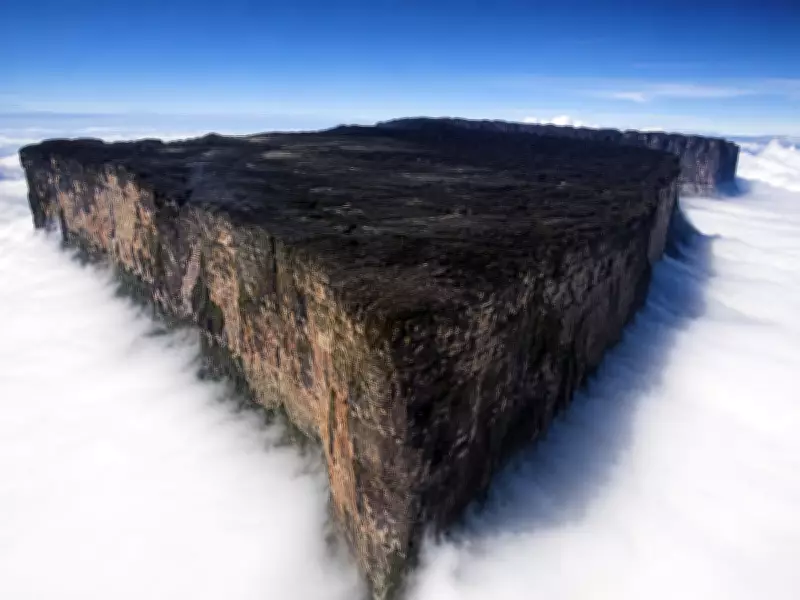
Imagine standing atop a mighty sandstone monolith, surrounded by erupting cloudscapes, completely cut off from the world. This is not a fantasy movie scene but the real-world reality of South America's Tepuis. These dramatic flat-topped mountains rise thousands of feet above the thick forest canopy covering Venezuela, Brazil, and Guyana, appearing as floating islands suspended in time. The local Indigenous Pemon people call them "tepuis," meaning "house of gods," and it is easy to understand why.
Sky Islands and Ancient Mysteries
Geologists estimate that the sandstone towers forming these plateaus are between 1.7 and 2 billion years old, making them among the oldest exposed rock formations on Earth. Over hundreds of millions of years, relentless erosion destroyed the surrounding landscape, leaving behind hundreds of small tablelands. Among these geological marvels, Mount Roraima stands out as a giant. Located at the borders of Venezuela, Brazil, and Guyana, this massive plateau measures 14 kilometers in length and 5 kilometers in width, with its southern edge reaching a dazzling height of 2,810 meters. The sheer cliffs of the Tepuis make it nearly impossible for lowland animals to reach the summits, creating highly secluded ecological zones. This extreme isolation has transformed Mount Roraima's summit into a living archive of time, where evolution has followed a distinct path.
The Bizarre and Mysterious Wildlife of an Undiscovered World
Life atop a Tepui mountain is both gorgeous and harsh. According to a fascinating study published in the European Journal of Taxonomy, the isolated, weathered mountaintops form ecological islands. This geographical isolation prevents species from mixing with lowland populations, resulting in remarkable endemism. Many species living on Mount Roraima cannot be found anywhere else on Earth. The range includes various mouse species, robust insects, and highly specialized amphibians. Scientists frequently investigate the unique behavior of the pebble toad, a tiny amphibian that cannot walk or swim. Instead, it evades predators by curling into a ball and rolling over the ancient rocks like a pebble. These survival strategies demonstrate how life evolves in a cloud-enshrouded environment over thousands of years.

The Stunning Predators of the Plateau
Plants on Mount Roraima have also adapted to the nutrient-poor, weathered sandstone soil. The most captivating species is Drosera kaieteurensis, a remarkable sundew plant. Characterized by a bright red hue that acts as a visible beacon on dark, wet rocks, its leaves are covered with delicate hairs tipped with a shiny, sugary substance resembling sweet nectar. According to an ecological study in Copeia, the extreme environmental challenges and infertile soils of the Pantepui region force plants to rely on specialized nutrient-gathering mechanisms. The sundew uses its sparkling, sugar-coated traps to lure unsuspecting insects. Once an insect lands, it becomes entangled in the sticky goo. The plant then slowly wraps around its victim and releases powerful enzymes that dissolve the prey, absorbing vital nutrients directly into the leaves.
For modern travelers and nature enthusiasts, Mount Roraima offers the ultimate off-the-beaten-path adventure. It provides a unique glimpse into an ancient, uninhabited world that has remained unchanged for centuries.