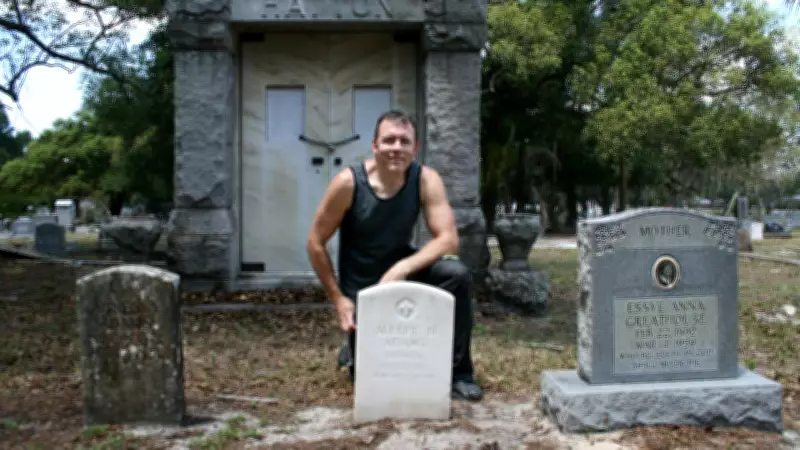
Long after most people leave work and head home, Andrew Lumish often spends his evenings walking quietly through old Florida cemeteries carrying soft brushes, buckets of water and specialised cleaning solutions. One gravestone at a time, he removes years of dirt, moss and biological growth from memorials that had become almost unreadable with age. Many belong to military veterans whose names were slowly disappearing beneath decades of weathering. Known online as “The Good Cemeterian,” Lumish has spent more than a decade voluntarily restoring neglected headstones across Florida, helping families, communities and strangers reconnect with the people buried beneath them. His work recently drew widespread attention after dramatic before-and-after images of restored graves went viral online.
How Andrew Lumish became “The Good Cemeterian”
Lumish, a specialty cleaner from Land O’ Lakes, Florida, did not originally plan to become known for cemetery restoration. More than ten years ago, he began visiting historic cemeteries around Tampa Bay and Ybor City to photograph old gravestones and learn about local history. During those visits, he noticed that many memorials, including those belonging to veterans, had become heavily stained, covered in algae or hidden beneath layers of dirt and biological growth. Some inscriptions were almost impossible to read. Instead of ignoring the problem, Lumish started researching professional preservation methods used by national cemeteries and monument conservators. He learned that many common cleaning methods, including bleach and pressure washing, could permanently damage fragile gravestones. What began as a personal interest slowly turned into a mission. By 2015, a local television segment about his volunteer work spread widely online, earning him the nickname “The Good Cemeterian.” Since then, his restoration work has been featured by national media outlets.
Restoring names nearly erased by time
One of Lumish’s most widely shared restorations recently involved the gravestone of Oscar Ayala, whose memorial had become darkened and difficult to read after decades of exposure to the elements. Using careful cleaning techniques, Lumish restored the stone’s appearance and revealed inscriptions that had nearly disappeared beneath grime and biological buildup. In the restored version, Ayala’s name and memorial inscription once again became clearly visible. The emotional power of Lumish’s work comes from moments like these. A gravestone that once looked abandoned suddenly becomes personal again once a name, date or message reappears. Many of the graves Lumish restores belong to veterans from conflicts stretching back generations, including the Civil War era. Others belong to ordinary people whose family memorials had slowly faded from view over time. Lumish often says the work is about restoring dignity and honour to the dead, especially veterans who served their country but whose graves were later neglected or forgotten.

The careful science behind grave restoration
A major part of Lumish’s work involves educating people about safe preservation techniques. Rather than using harsh chemicals or abrasive tools, he relies on methods designed to protect delicate stone surfaces. One of the products frequently associated with his restorations is D/2 Biological Solution, a cleaner widely used by monument preservation experts because it removes biological growth without damaging historic materials. Lumish typically combines the solution with water, soft brushes and patient manual cleaning. Conservation experts have repeatedly warned that amateur gravestone cleaning using bleach, wire brushes or power washers can permanently erode stone surfaces and destroy inscriptions forever. Older marble and limestone markers are especially vulnerable. Because of this, Lumish has also spent years teaching workshops and sharing proper restoration practices online so volunteers can help preserve historic cemeteries safely.

Why his work resonates so deeply online
In an internet culture dominated by outrage and fast-moving trends, Lumish’s quiet volunteer work has struck an emotional chord with millions of people. Part of the reason is the visual transformation itself. The before-and-after images are dramatic, often revealing details hidden for decades beneath layers of dirt and moss. But the deeper impact comes from what the restorations represent. Each cleaned gravestone reconnects someone to history, whether it is a forgotten veteran, a grieving family member or a local community’s past. Names that once seemed close to disappearing become visible again. For Lumish, the goal has never been internet fame. His work is rooted in the belief that every person deserves to be remembered, especially those who served their country and can no longer speak for themselves. One restored headstone at a time, “The Good Cemeterian” is making sure they are not forgotten.