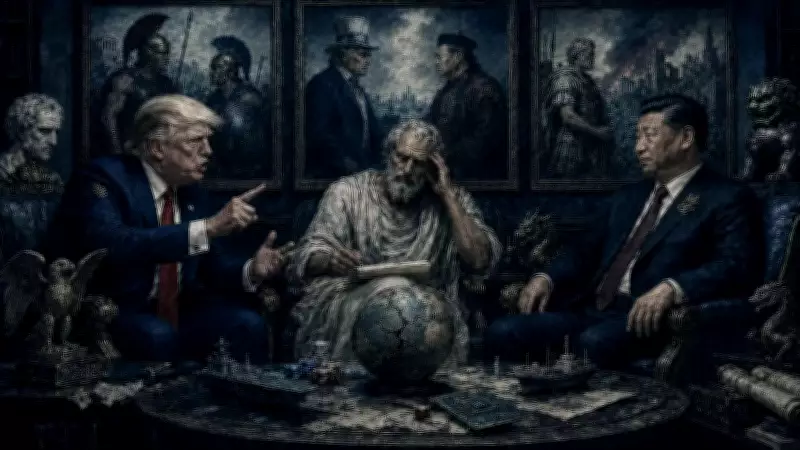
For those unfamiliar, there is a website called Jmail that has repurposed Jeffrey Epstein's emails into a Gmail format, making it appear as though one is browsing the late paedophile's inbox. It is a treasure trove of nonsensical information that revealed how deeply entrenched a former high school teacher with no formal graduation degree had become in manufacturing contacts among the high and mighty. Among these gems are numerous exchanges with Noam Chomsky, the man who explained how elites manufacture consent but still perhaps could not avoid the temptation of associating with those who manufactured it. One hilarious repartee involved Epstein writing to Chomsky: "Donald Trump has written three books. That makes him one of the few people in the world who has written more books than he has read."
Ergo, it is highly unlikely that Trump has heard of Thucydides, the 5th-century BCE Athenian historian who argued that war between a ruling power and an emerging power was inevitable. He surmised: "It was the rise of Athens and the fear that this instilled in Sparta that made war inevitable." This is the trap that 'Philosopher King' Xi Jinping wants to avoid when confronting Don Tzu, but who is Thucydides anyway? What trap did he lay? And will the US and China go to war?
Thucydides – Who, What, Why
There is an ontological moment in Avengers: Infinity War when Star-Lord asks Iron Man: "Who is Gamora?" Iron Man says he will do one better: "Who is Gamora?" Drax quips: "Why is Gamora?" So, who is Thucydides? Why is he mentioned here? And what is the Thucydides Trap?

Thucydides was an Athenian historian and general who wrote History of the Peloponnesian War, an account of the ruinous conflict between Athens and Sparta that lasted from 431 BCE to 404 BCE. He wrote the book because he had a healthy disdain for historians embellishing war accounts with talk of gods and storytelling. He stated: "...but I have written not for immediate applause but for posterity, and I shall be content if the future student of these events, or of other similar events which are likely in human nature to occur in after ages, finds my narrative of them useful." It is a useful narrative, explaining how Athens, a rising power, threatened Sparta, leading to war.
In modern parlance, the "Thucydides Trap" was popularised by Harvard political scientist Graham Allison to describe the danger of how an established power reacts to an upstart. Allison's Harvard Belfer Center project studied 16 such cases over 500 years, finding that 12 ended in war, though none were post-World War II or since the global economic system became interdependent or the nuclear age arrived.
The Lesson from History
History is not a spreadsheet, but patterns repeat. When a new power rises, the old power gets nervous, and things go south. This happened in the Franco-Prussian War of 1870-71. France wanted to stop Prussia from becoming too powerful, but Bismarck used the war to unite German states, defeat France, capture Napoleon III, and declare the German Empire at Versailles in 1871. France tried to stop a future it feared and helped create it.
The same fear shaped Europe before World War I. Germany was rising fast after unification in 1871. Britain feared German naval power, Germany feared encirclement by Britain, France, and Russia. Russia's recovery after its defeat by Japan in 1905 made German planners believe time was running out. Then, in 1914, one assassination in Sarajevo turned Europe's anxieties into a world war.
Japan's road to Pearl Harbor offers another warning. In 1941, after years of Japanese expansion in Asia, the US imposed restrictions, including an oil embargo. Japan saw war as better than slow strangulation. On December 7, 1941, it attacked Pearl Harbor. Great powers rarely enter war claiming villainy; they claim they had no choice. That Faustian bargain led to two small visitors called Little Boy and Fat Man.
But history also shows escape is possible. Portugal and Spain avoided war over overseas empires. Britain and America avoided war in the early 20th century because Britain gradually accepted America's dominance in the Western Hemisphere. During the Cold War, from 1947 to 1991, the US and Soviet Union fought through proxies, spies, arms races, and ideology, but never directly.

US vs China – Clash of Worldviews
When Trump was first elected in 2016, Xi had a hard time understanding America's choice and told Barack Obama: "If an immature leader throws the world into chaos, then the world will know who to blame." These words proved oddly prophetic, making Xi's invocation of Thucydides intriguing as America and China joust over tariffs, Taiwan, and semiconductors.
At the heart of the battle is something deeper. If the Cold War was ostensibly over ideology, America's and China's differences stem from different philosophical worldviews, though one could argue America no longer fully subscribes to that worldview under MAGA.
America was formed because it never wanted to be ruled by a king again. Its founding myth is rebellion: tea thrown into a harbour, pamphleteers denouncing tyranny, farmers with muskets facing an empire, and a republic built around the suspicion that any ruler given too much power will eventually seek a throne. The American state was designed to frustrate power: divide it, check it, litigate it, mock it, drag it through Congress, leak against it, subpoena it, and vote it out before it speaks in the royal "we." Today, it views itself as the inheritor of Athens, Rome, Magna Carta, the British constitutional tradition, and the European Enlightenment, as Marco Rubio evoked while warning Europeans about "civilisational erasure."
China, on the other hand, does not fear the king; it often reveres him. What it fears is chaos: the kingdom falling apart. Its ultimate nightmare is dynastic collapse, with warlords running amok and demagogues setting up parallel governments. The Chinese political imagination is haunted by the broken realm. The ruler may be harsh, but the absence of order is remembered as worse.
So America's founding warning is: never again a king. China's civilisational warning is: never again a broken kingdom. That is why the two countries talk past each other. When America speaks of liberty, China hears disorder. When China speaks of stability, America hears tyranny. America built a republic to stop Caesar; China built a state to stop the empire from shattering.
Xi's authoritarian philosophy is unique: he uses Confucius for legitimacy, Han Feizi for discipline, Lenin for organisation, and Silicon Valley for surveillance—old civilisational language to justify a modern party-state of censorship, control, and technological discipline. Washington, which gave China too much leeway during the Cold War and helped knit it into the global economy, now views Beijing as its first real challenger since the Soviet Union.
There are fundamental differences between the Bear and the Dragon. The Soviet Union cajoled, threatened, and seduced the world with ideology, creating outposts from Vietnam to Cuba. China, however, is like a giant Avatar tree with the world plugged into its glowing sockets. It dominates supply chains, buys commodities, builds infrastructure, competes in AI, and sits inside the global economy in a way that it can be mistrusted but never eradicated.
Today, America is less Monroe and more Donroe, whose doctrine is simpler: don't pretend the rules-based international order exists; admit America is best; make a deal; seek revenge; and assert dominance. The rub is that China is one country Trump cannot coerce or bully into submission. Xi wants to avoid the Thucydides Trap because he realises that given the nature of American democracy, MAGA may dominate a season, but it is not the American state. He is not merely negotiating with Trump; he is negotiating with a system that will produce successors, factions, reversals, and corrections.
The N-Deterrent and Global Economy
The final word on the Thucydides Trap involves two things Athenians and Spartans never had: nuclear weapons and economic dependency. Since 1945, great powers have discovered that direct war between nuclear states is less an instrument of policy and more a suicide note with launch codes. The US-Soviet rivalry never went hot because both knew all-out war meant annihilation. They fought through proxies, coups, spies, arms races, propaganda, ideology, and on Ivy League campuses.
Also, unlike the US and USSR, the US and China are tied at the hip economically. America needs Chinese manufacturing, minerals, markets, and supply chains. China needs American consumers, technology access, capital flows, and global legitimacy. This does not make war impossible—human beings have never allowed common sense to permanently interfere with stupidity—but it makes war far more ruinous than the old model suggests. In Thucydides' world, rivals could burn each other's cities. In ours, they can burn the global economy, irradiate the future, and discover neither side has technically won.
That is why the Athens-Sparta template is incomplete. Since 1945, great powers have avoided direct war not because they became wiser but because nuclear weapons and economic interdependence turned victory into a very expensive form of suicide.
The Carthage Curse
Finally, there is something beyond the Thucydides Trap that requires both China and America to stay sane: the Carthage Curse. Sallust, the Roman historian, warned in Bellum Catilinae: "After the destruction of Carthage, when fear of a rival had been removed, fortune began to grow cruel. All the evils that prosperity fosters—luxury, greed, arrogance—flourished. For before that time, fear of the enemy had kept the state sound. When that fear was gone, pleasure and pride entered, and with them decay."
In the Thucydides Trap, a ruling power and a rising power can destroy each other through fear. In the Carthage Curse, a power destroys itself because no rival is left to discipline it. That is the darker warning: a rival can kill you, but the absence of a rival can rot you. America discovered this after the Soviet Union collapsed. The unipolar moment arrived, the "end of history" became elite mood music, and then came overreach, Iraq, financialisation, institutional decay, culture war, conspiracy politics, and finally Trump. America did not begin to fray because China rose; China rose into a world where America had already started arguing with itself.
China should read Sallust too. America is Beijing's disciplining enemy. Its pressure allows Xi to demand unity, sacrifice, technological self-reliance, and obedience. But if China were to get the world it wants—with America humbled, Asia rearranged, and the party-state vindicated—what then? Would discipline remain, or would triumph breed its own arrogance, corruption, and decay?
That is the final trap. Thucydides warns that fear of a rival can lead to war. Sallust warns that the absence of a rival can lead to rot. Between them lies the cursed logic of great powers: too much fear can destroy you from outside; too little fear can destroy you from within. So even if America and China avoid Thucydides, Carthage will still be waiting. History's cruelest joke is that empires can survive their enemies and still lose to themselves.
Yet for now, the world does not need either lesson tested. It merely needs the two most powerful countries to avoid turning history into a live demonstration. So hopefully, Trump will declare victory, Xi will convince Iran to back off (not out of charity but because China needs oil, shipping lanes, and a world economy that hasn't been set on fire), and the rest of us can breathe a little more peacefully.
About the Author
Nirmalya Dutta is an editorial consultant with The Times of India. He covers world news, pop culture, and philosophical memes. He writes the column Random Musings and The Weekly Vine, a newsletter that blends news, culture, and humour with a touch of chaos. He is also the co-creator of Meow Times, a satirical cartoon strip about the absurdities of corporate life. His political, moral, and economic views drift somewhere between woke-Leninist, Rand-Marxist, and Keynesian-Friedmanite, though he isn't entirely sure what any of those terms mean.