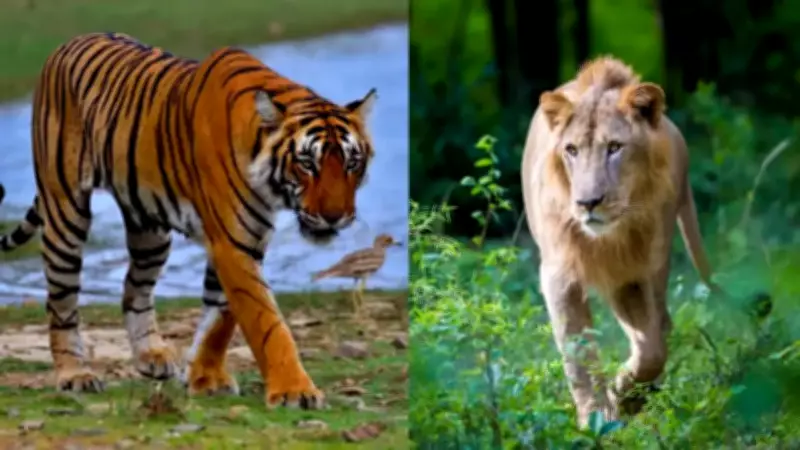
The age-old debate over which animal would emerge victorious in a fight between a tiger and a lion has captivated animal enthusiasts for generations. Though these two majestic creatures rarely cross paths in the wild today, both belong to the elite group of nature's fiercest predators, often hailed as kings of the savanna or the jungle. However, answering this question requires more than simply declaring one superior to the other. Factors such as physical strength, agility, hunting prowess, and combat experience must all be considered. According to the Environmental Literacy Council, tigers appear to have an advantage when it comes to size and raw power.
Size and Power: Tiger Takes the Lead
One of the primary considerations is size. Male tigers, particularly Bengal and Siberian tigers, tend to be bulkier than their African lion counterparts. Some male tigers can exceed 250 kilograms in weight, surpassing the maximum weight of a male African lion. Size often correlates with muscle mass. Additionally, tigers possess exceptionally strong forelimbs and shoulder muscles, enabling them to take down large prey like wild boars, deer, gaur, and buffaloes single-handedly. Tigers are solitary hunters, relying entirely on their physical prowess. Lions, however, are far from weak. Males spend their lives defending territory against rivals, with muscular necks, broad chests, and protective manes making them formidable opponents. Nonetheless, many naturalists concede that the tiger holds a slight edge in raw strength. HowStuffWorks notes that tigers are bigger and stockier, earning them a reputation as the stronger animal.
Speed and Agility: A Close Contest
Both big cats exhibit impressive speed. Lions can sprint at up to 80 km/h (50 mph), while tigers reach about 65 km/h (40 mph) in short bursts. Neither is built for sustained high speeds; instead, they rely on rapid acceleration to overwhelm prey. The key difference lies in agility. Tigers inhabit densely wooded areas and are adept swimmers, maneuvering stealthily through undergrowth and rough terrain. Their lithe bodies allow for great leaps, with reports of tigers jumping several meters in a single bound while hunting. Lions, adapted to open savannahs, often hunt cooperatively rather than executing complex maneuvers in dense foliage. While fast and nimble, lions do not match the agility of tigers. The Environmental Literacy Council suggests that comparisons often rank tigers above lions in agility, though maximum speeds are similar.

Hunting Skills: Solitary vs. Cooperative
This aspect reveals the most fascinating contrast. Lions are social animals hunting in prides, where lionesses collaborate to catch large prey like zebras, wildebeests, and buffaloes. Teamwork allows them to encircle and subdue animals much larger than themselves. Tigers, on the other hand, are solitary hunters. Without a pride for support, they rely entirely on stealth and timing, stalking prey for hours before striking at the perfect moment. Biologists consider tigers among the most competent solitary hunters in the wild, capable of taking down prey that outweighs them. However, lions excel in cooperative hunting, making them extraordinarily formidable when working as a team.
Who Emerges Victorious?
When comparing individual hunting capabilities, the tiger gains the upper hand. In team-based scenarios, the lion becomes a superior adversary. Thus, the winner depends on context: tiger wins in one-on-one hunting, while lion wins in team hunting.
Expert Opinions and Findings
This debate has long engaged scientists, wildlife enthusiasts, and media. HowStuffWorks notes that tigers typically have the advantage in size and solitary hunting, while lions benefit from cooperation. Studies by environmental education institutions indicate that tigers generally come out slightly ahead in one-on-one fights due to size, muscularity, and agility. However, experts emphasize that outcomes depend heavily on factors like age, health, experience, and individual temperament.

Conclusion
Despite being called the "King of the Jungle," lions do not actually inhabit jungles. Tigers, residing in forests, have evolved as highly effective lone hunters. In terms of physical attributes like strength, agility, and independent hunting ability, the tiger holds a slight edge. It is a large, muscular, stealthy predator capable of solo kills. Ultimately, it is more reasonable to admire both cats as outstanding creations of nature rather than declaring one superior. The tiger excels as a solitary hunter, while the lion is unmatched in cooperation and teamwork. Any comparison remains largely hypothetical, as these species rarely meet in the wild, and outcomes are influenced by numerous variables.