

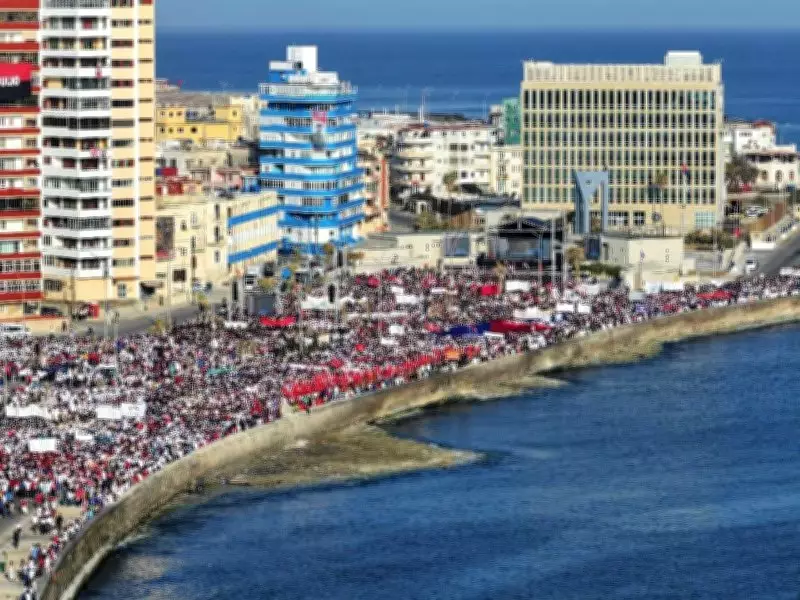
Former US President Donald Trump has made a bold statement regarding Cuba, declaring that he will be taking over the island nation almost immediately. This announcement has sent shockwaves through diplomatic circles and raised questions about the future of US-Cuba relations.
Trump's Statement
During a recent public appearance, Trump asserted his intention to assert control over Cuba, stating that the process would begin shortly. He did not provide specific details on how this takeover would be implemented or what legal basis he would use to justify such an action.
Reactions from Cuba and the International Community
The Cuban government has strongly condemned Trump's remarks, calling them a violation of international law and a threat to Cuba's sovereignty. Other world leaders have also expressed concern, with many emphasizing the importance of respecting national borders and self-determination.

International relations experts have pointed out that any attempt by the US to take over Cuba would likely face significant legal and diplomatic hurdles. The United Nations Charter explicitly prohibits the acquisition of territory by force, and such a move could lead to widespread condemnation and sanctions.
Historical Context
US-Cuba relations have been fraught with tension for decades, dating back to the Cold War era. The US imposed a trade embargo on Cuba in 1960, which remains in effect today. In recent years, there have been efforts to normalize relations, but Trump's latest statement threatens to reverse any progress made.
During his presidency, Trump took a hardline stance against Cuba, tightening sanctions and reversing many of the Obama-era policies aimed at rapprochement. His latest comments suggest he intends to continue this approach if he returns to power.
Legal and Political Implications
Legal scholars argue that a US takeover of Cuba would be illegal under both domestic and international law. The US Constitution does not grant the president the authority to unilaterally annex foreign territory, and any such action would require congressional approval. Moreover, the United Nations Security Council would likely block any attempt at annexation.
Politically, Trump's statement could be seen as an attempt to rally his base ahead of the upcoming election. However, it also risks alienating moderate voters and damaging America's reputation on the global stage.
What Comes Next?
It remains unclear what specific actions Trump plans to take regarding Cuba. His campaign has not provided further details, and it is possible that the statement was made in a rhetorical context. Nevertheless, the international community will be watching closely to see if any concrete steps are taken.
In the meantime, the Cuban government has called for dialogue and reaffirmed its commitment to defending its sovereignty. The United States government, under President Biden, has not officially responded to Trump's remarks, but it is expected to reiterate its support for diplomatic solutions.






