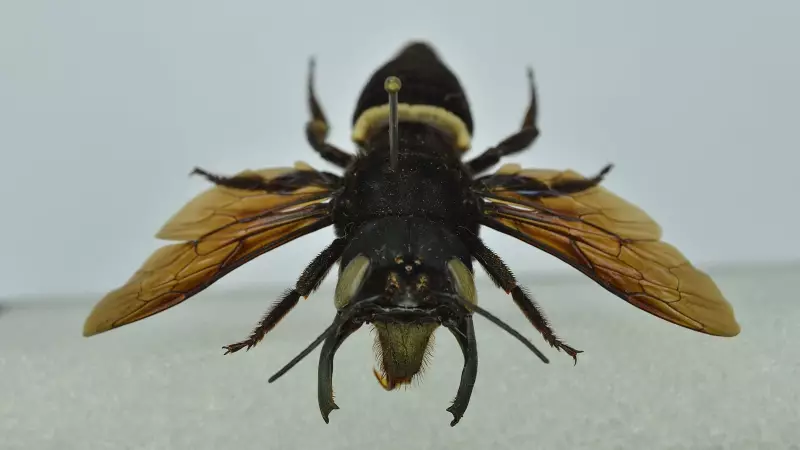
In the dense, remote rainforests of Indonesia, a true giant of the insect world, missing for decades, made a dramatic return. Wallace's Giant Bee, famously nicknamed the 'flying bulldog', is the planet's largest bee and a creature of immense fascination and mystery.
The Lost and Found Giant
This remarkable insect was first discovered over 160 years ago by the British naturalist Alfred Russel Wallace. After that initial encounter, it seemingly vanished from scientific view, becoming a ghost that eluded explorers and entomologists for generations. For many years, it was feared extinct. That changed in 2019, when a search team from The Search for Lost Species, a Global Wildlife Conservation (GWC) initiative, made a stunning rediscovery on the Indonesian island of North Moluccas. The find sent waves of excitement through the global scientific community.
Why the 'Flying Bulldog'?
The bee's intimidating nickname is a perfect fit. The females are colossal, reaching lengths of 1.5 inches (3.8 cm)—about four times the size of a common honeybee—with a wingspan of approximately 2.5 inches (6.3 cm). Its build is muscular, and its buzz is deep and formidable. With its oversized mandibles and black, armoured body, it resembles a flying tank more than a delicate pollinator.

Clay Bolt, the specialist photographer who captured the first live images, described the moment to The Guardian: "It was absolutely breathtaking to see this 'flying bulldog' of an insect that we weren't sure existed any more. To actually see how beautiful and big the species is in life, to hear the sound of its giant wings thrumming as it flew past my head, was just incredible."
A Solitary Life in Termite Towers
Wallace's Giant Bee (Megachile pluto) is a solitary creature, not living in hives. It makes its home exclusively in the lowland forests of Indonesia, particularly North Moluccas. Its nesting habit is extraordinary: it uses its powerful jaws to scrape resin and carve out nesting chambers inside active termite mounds, often several meters above the ground. This resin-lined fortress provides waterproof protection for its young from predators and the elements.
This very secretive lifestyle, combined with the remoteness of its habitat and critically low population numbers due to deforestation, made it nearly impossible to find. Before the 2019 sighting, the last confirmed observation was in 1981.
Facing an Uncertain Future
Despite the joyful rediscovery, the future of Wallace's Giant Bee remains precarious. The International Union for Conservation of Nature (IUCN) lists it as "Vulnerable". Its forest home faces relentless pressure from deforestation, logging, and agricultural expansion. Alarmingly, the bee also faces a threat from illegal wildlife trade. Before its rediscovery, a specimen was reportedly sold on eBay for $9,100, highlighting the urgent need for protection.
The story of the flying bulldog is a powerful reminder of the hidden wonders in our world and the constant vigilance needed to protect them from disappearing forever.