

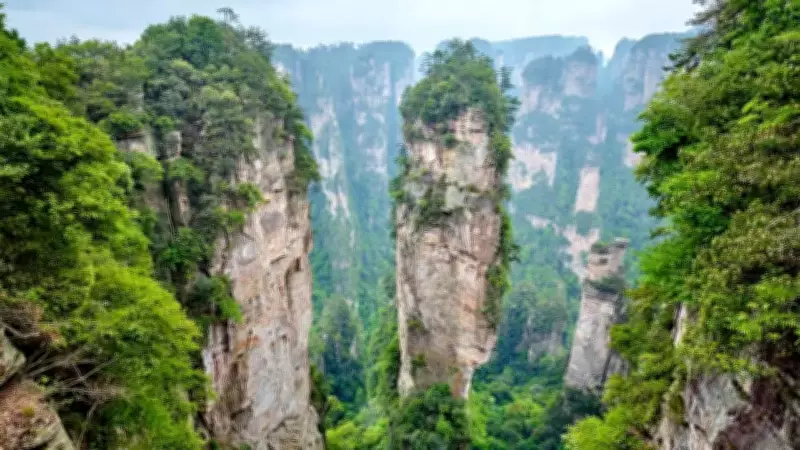
For many people, the first glimpse of Pandora in Avatar felt almost impossible to process. Mountains drifted through the sky, suspended above clouds and connected by forests hanging in mid-air. The landscape looked like pure fantasy, the sort of place that could only exist inside a visual effects studio.
Yet the roots of that vision lie in a very real corner of central China. Hidden among the mountains of Hunan Province is a landscape so unusual that even photographs can seem misleading. Vast stone pillars rise from the earth in clusters, disappearing into mist and cloud. On some mornings, only their upper reaches are visible, giving the impression that entire mountains have detached themselves from the ground. According to the BBC, the dramatic scenery of Zhangjiajie became widely associated with the floating Hallelujah Mountains seen in Avatar, transforming a once lesser-known destination into one of China's most recognised natural attractions.
Wulingyuan: The real-life landscape behind Avatar’s floating mountains
The broader region is known as the Wulingyuan Scenic and Historic Interest Area, a UNESCO World Heritage Site inscribed in 1992. UNESCO describes it as a vast protected landscape covering more than 26,000 hectares and containing thousands of towering quartz sandstone pillars, many rising well over 200 metres above the surrounding terrain. What makes the scenery so striking is not simply the height of these formations but their sheer number. Rather than a single dramatic peak dominating the horizon, the landscape unfolds as a forest of stone. Narrow columns emerge from deep valleys, while ravines, streams, waterfalls and caves weave between them. UNESCO notes that more than 3,000 sandstone pillars and peaks are scattered throughout the site, creating one of the world's most distinctive mountain environments.

The effect changes constantly with the weather. Low cloud drifts through the valleys, obscuring the lower slopes and leaving the tops seemingly suspended above a white sea of mist. It is easy to understand why visitors often compare the scene to a painting rather than a real place.
How Zhangjiajie became the real-life inspiration behind Avatar’s floating mountains
Before James Cameron's science-fiction epic reached cinemas, Zhangjiajie was already known within China for its unusual geography. Outside the country, however, it remained far less familiar than destinations such as Beijing, Shanghai or Guilin.
The connection with Avatar changed that. According to the BBC, visitors increasingly arrived seeking the landscape that reminded them of Pandora's floating mountains. One particular sandstone pillar became especially famous after local tourism authorities linked it to the film's imagery. Originally known as the Southern Sky Column, the formation rises more than a thousand metres and stands apart from many surrounding peaks, making it one of the area's most photographed landmarks.
The resemblance is not literal. The mountains in Avatar float freely in the air, while Zhangjiajie's pillars remain firmly rooted to the ground. Yet when clouds gather around their bases, the distinction becomes surprisingly easy to forget. From certain viewpoints, the stone columns seem to emerge directly from the sky itself.
The natural wonders that make Wulingyuan globally significant
The popularity of the Avatar connection sometimes overshadows the fact that Wulingyuan holds international significance in its own right.
UNESCO recognised the site primarily for its exceptional natural beauty. The organisation highlights not only the sandstone pillars but also natural stone bridges, caves, streams, pools and extensive forest cover. Together, these elements create a landscape that changes character from one valley to the next.
The region also supports important wildlife habitats. UNESCO notes that endangered species have been recorded within the area, including the dhole, the Asiatic black bear and the Chinese water deer. Dense vegetation blankets much of the landscape, softening the rocky terrain and providing refuge for a diverse range of plants and animals.

This combination of geological spectacle and ecological importance helped secure the site's place on the World Heritage List, ensuring international recognition long before Hollywood turned its attention to floating mountains.
Protecting the real-life inspiration behind Avatar’s floating mountains
Success brings complications. As visitor numbers increased, concerns emerged about development inside the scenic area. UNESCO records that authorities introduced stronger protection measures during the late 1990s and early 2000s, including the removal of some buildings and efforts to reduce pressures on sensitive parts of the landscape. Today, management focuses on maintaining a balance between conservation and tourism. Visitor centres, monitoring programmes and environmental regulations are all part of the long-term effort to protect the scenery that made Wulingyuan famous.
For travellers, the experience can vary dramatically depending on the weather. On clear days, endless ranks of stone pillars stretch across the horizon. On misty mornings, entire valleys disappear beneath clouds. As per the BBC, these shifting conditions often create the most memorable views, transforming the landscape into something that feels suspended between earth and sky.
The film offered a visual reference point, but the landscape itself remains the greater spectacle, a place where geology, weather and scale combine to produce scenes that can seem almost unreal, even when standing right in front of them.





