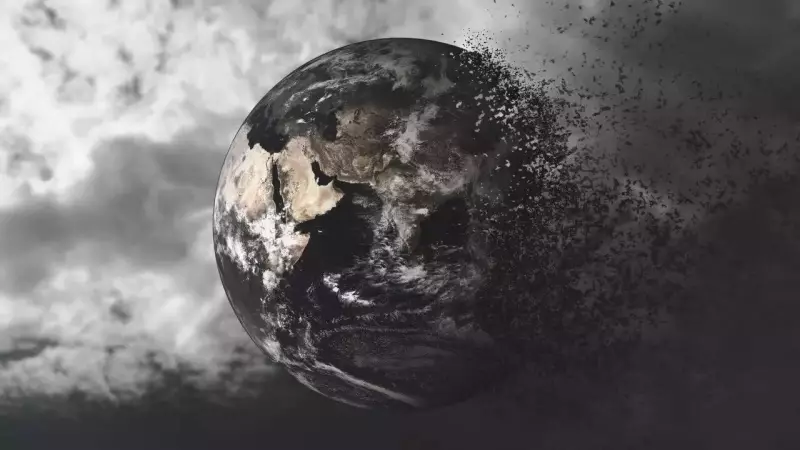
Every so often, a startling piece of news from the past makes the rounds online: a group of scientists once used mathematics to calculate the exact date for the end of the world. While it sounds like the plot of a science fiction movie, this prediction actually originated from serious academic research in the 1960s, reflecting deep anxieties about humanity's path during an era of swift global transformation.
The Doomsday Equation: A Mathematical Warning
Back in 1960, researchers Heinz von Foerster, Patricia M. Mora, and Lawrence W. Amiot at the University of Illinois undertook a fascinating study. They analyzed global population data spanning nearly two millennia. When they plotted this historical information, they uncovered a disturbing trend. The world's population wasn't just increasing; its growth rate was accelerating at a frightening pace.
This pattern led to a critical question: if this acceleration continued unchecked, what could possibly bring it to a halt? The world at that time was recovering from two World Wars. Despite the immense loss of life, the global population had surged from about 1.6 billion in 1900 to roughly three billion by 1960. Breakthroughs in medicine, sanitation, and farming had slashed death rates, but birth rates in many areas stayed high, creating what seemed like an unsustainable imbalance.

By extending their population curve into the future, their mathematical model produced a shocking result. It indicated that population growth would mathematically approach infinity on Friday, 13 November 2026. This date, published in a study for Science, was never meant to be a literal prophecy. An infinite population is physically impossible. Instead, it served as a powerful symbolic marker, showing the point at which the existing runaway growth trend would inevitably collapse.
What Did the Researchers Really Fear?
The team did not forecast a sudden, dramatic apocalypse. Their warning was more nuanced and perhaps more chilling. They cautioned that extreme population density would severely diminish an individual's chance of survival. Humanity, they argued, would face immense pressure from overcrowding, resource depletion, and environmental strain.
Their conclusion was grim yet measured. They wrote that humanity might not necessarily starve to death, but could be "crushed by the limits of its own environment" if population growth continued without restraint.
Why the Prediction Didn't Come True: A Changed World
More than sixty years later, the foundational assumptions of that 1960 equation have shifted dramatically. While the global population has indeed ballooned to over eight billion people, its growth rate has slowed significantly. Across the globe, social, economic, and educational changes have led people to choose smaller families.
Current projections from the United Nations paint a very different picture. They suggest the global population will likely peak in the 2080s and then start a gradual decline. This fundamental change in demographic trajectory completely alters the future the original model was based upon.
The Real Scientific Timeline for Earth's End
If we are looking for a scientifically grounded estimate for when life on Earth could truly end, modern research points to a timeline almost unimaginably far in the future. Scientists, including a team from Japan's Toho University collaborating with NASA researchers, have simulated the future evolution of our Sun and Earth's atmosphere.
Their findings suggest that in about one billion years, increasing solar radiation will have catastrophic effects. It will strip oxygen from the atmosphere, cause the oceans to evaporate, and push surface temperatures far beyond what any known life could endure. This cosmic timescale offers a stark contrast to the human-centered fears of the 1960s, reminding us that while our societal challenges are urgent, the planet's story is measured in eons.