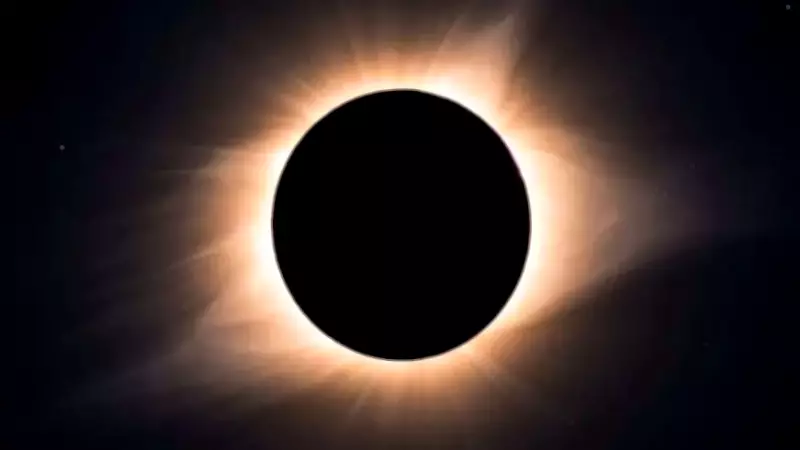
First Solar Eclipse of 2026: An Annular 'Ring of Fire' Event
On Tuesday, February 17, 2026, the world will witness the inaugural solar eclipse of the year, a spectacular annular phenomenon often dubbed the "Ring of Fire." This celestial event occurs when the Moon aligns between the Earth and the Sun, but due to its position being farther away in orbit, it fails to completely obscure the solar disk. Instead, a brilliant, fiery ring of sunlight remains visible around the Moon's edges, creating a mesmerizing visual spectacle that captivates astronomers and skywatchers globally.
Why the Eclipse Will Be Invisible from the UAE
For residents of the United Arab Emirates, there is a significant catch: the eclipse's "Path of Annularity" is exceptionally narrow and remote, sweeping almost exclusively over the frozen continent of Antarctica. The alignment occurs while the Sun is below the local horizon in the UAE, rendering the event entirely invisible from the region's skies. Consequently, the Burj Khalifa and other iconic landmarks will not experience the dramatic darkening associated with solar eclipses, though the occurrence remains a pivotal scientific milestone for researchers worldwide.
Understanding the 'Ring of Fire' Phenomenon
The term "Ring of Fire" refers to the bright circle of sunlight that persists during an annular solar eclipse. Unlike a total solar eclipse, where the Moon completely blocks the Sun and plunges areas into temporary darkness, an annular eclipse never achieves full obscuration. This is because the Moon appears slightly smaller in the sky due to its increased distance from Earth, leaving a thin, glowing halo around its silhouette. During the February 17, 2026 event, this striking ring effect is expected to last for up to approximately two minutes and twenty seconds at peak viewing locations in Antarctica, offering a brief but breathtaking display.

How to Watch the Eclipse from the UAE
Although direct viewing from the UAE is impossible, enthusiasts do not have to miss out on the show. Several space agencies and research stations in Antarctica are preparing to broadcast the event via live streams. The partial phase of the eclipse begins at 1:56 PM UAE time (GST), with the "Ring of Fire" reaching its peak at 4:12 PM UAE time. To enjoy the celestial choreography without enduring a 14-hour flight or sub-zero temperatures, viewers can tune into high-definition broadcasts from organizations such as NASA or the Virtual Telescope Project. These streams will provide real-time views from the desolate Antarctic landscape, allowing global audiences to partake in the experience remotely.
Future Eclipses and Astronomical Highlights in 2026
If the February eclipse feels like a missed opportunity, there is encouraging news on the horizon. A total solar eclipse is scheduled for August 12, 2026, visible across parts of Europe, including Spain and Iceland. While this event will also not be observable from the UAE, its geographical proximity may attract eclipse chasers from the region planning travel adventures. Additionally, 2026 promises other astronomical highlights, such as lunar eclipses and meteor showers, some of which may be visible from UAE skies, offering local stargazers alternative celestial events to anticipate.
This annular solar eclipse underscores the dynamic nature of our solar system and the importance of global collaboration in scientific observation. As technology bridges geographical gaps, events like these become accessible to all, fostering a deeper appreciation for astronomy and the wonders of the universe.