

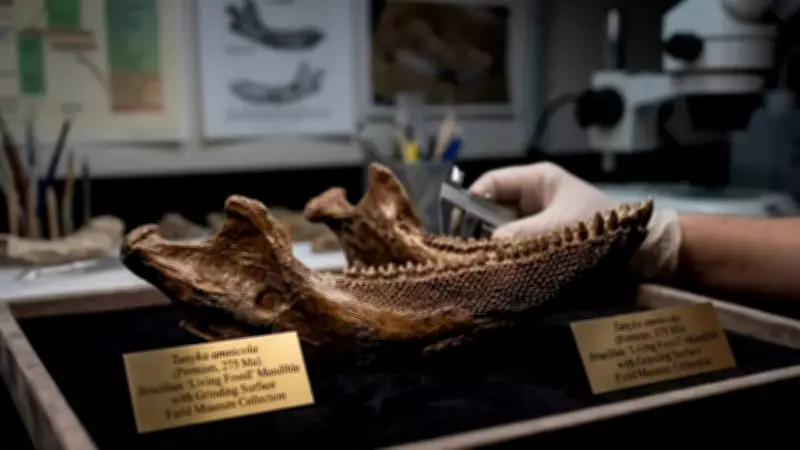
Groundbreaking Discovery of 275-Million-Year-Old 'Living Fossil' in Brazil
In a remarkable paleontological breakthrough, researchers analyzing fossils from Brazil have identified an entirely new species of tetrapod dating back an astonishing 275 million years. This ancient creature, officially named Tanyka amnicola, is being hailed as a "living fossil" for its time due to its highly unusual and bizarre jaw structure that defies conventional evolutionary expectations.
The Bizarre Jaw Structure That Baffled Scientists
The most striking feature of Tanyka amnicola is its extraordinary mandible configuration. The lower jaws of this three-foot-long creature exhibited a peculiar twist that caused the primary teeth to point outward toward the cheeks rather than upward as seen in most vertebrates. This unique anatomical arrangement created a dental configuration unlike anything previously documented from the Permian period.
Adding to this remarkable structure, the interior surface of Tanyka's lower jaw was completely covered with hundreds of tiny, sharp denticles arranged in a pattern reminiscent of modern cheese graters. According to research published in the prestigious journal Proceedings of the Royal Society B, this dense field of denticles likely rubbed against the upper jaw during feeding, creating an effective grinding mechanism for processing tough plant material.

A Herbivorous Pioneer from Gondwana's Isolated Ecosystems
This specialized jaw adaptation provides compelling evidence that Tanyka amnicola represents one of the earliest known herbivorous vertebrates in the fossil record. The creature's dental apparatus was perfectly suited for consuming and processing a wide variety of aquatic plants that other Permian-period herbivores would have struggled to digest efficiently.
Lead researcher Jason Pardo from the Field Museum draws an intriguing parallel between Tanyka and modern evolutionary anomalies, stating: "Tanyka can be compared to the platypus in its ability to thrive during an era when most other vertebrates had evolved more advanced characteristics. This creature represents a relict lineage that persisted long after its closest relatives had vanished from the fossil record."
The 'Guaraní Jaw' and Its Southern Hemisphere Significance
The discovery holds particular importance for understanding southern hemisphere paleontology. Most Permian period knowledge has been documented from Northern Hemisphere sites in Laurussia, but Tanyka amnicola provides crucial insights into Gondwana—the massive supercontinent that dominated the southern hemisphere.
The naming of this remarkable fossil reflects both its anatomical features and geographical origins. The genus name "Tanyka" derives from the Guaraní language spoken by indigenous peoples in the Brazilian region where the fossil was discovered, translating simply to "jaw." The species designation "amnicola" comes from Latin, meaning "of the river," referencing the aquatic environment where this creature thrived.
Survival in Gondwana's Unique Lacustrine Environments
Geological analysis of the Pedra de Fogo Formation reveals that Tanyka inhabited complex freshwater ecosystems characterized by numerous interconnected lakes and rivers within the Parnaíba Basin. These high-stability lacustrine systems created isolated ecological conditions that allowed Tanyka to survive as a "living fossil" long after its closest relatives had gone extinct elsewhere in the world.
The National Science Foundation notes that this discovery suggests South American ecosystems during the Permian period hosted unique evolutionary experiments and lineages that existed nowhere else on Earth. Tanyka occupied a specialized herbivorous niche that enabled its survival in these isolated Gondwanan environments for approximately 60 million years after similar species had disappeared from the fossil record elsewhere.
Redefining Our Understanding of Permian Biodiversity
This extraordinary fossil discovery fundamentally alters our comprehension of Permian-period ecosystems and evolutionary dynamics. Tanyka amnicola provides scientists with a rare window into the distinctive, isolated ecosystems of Gondwana that fostered evolutionary pathways unseen in northern continents.

The creature's persistence as a relict lineage demonstrates how unique ecological conditions can preserve ancient biological forms long after they have disappeared from other regions. As research continues, Tanyka promises to reveal further insights about herbivorous adaptations, southern hemisphere paleoecology, and the complex evolutionary history that shaped life on Earth during one of geology's most transformative periods.





