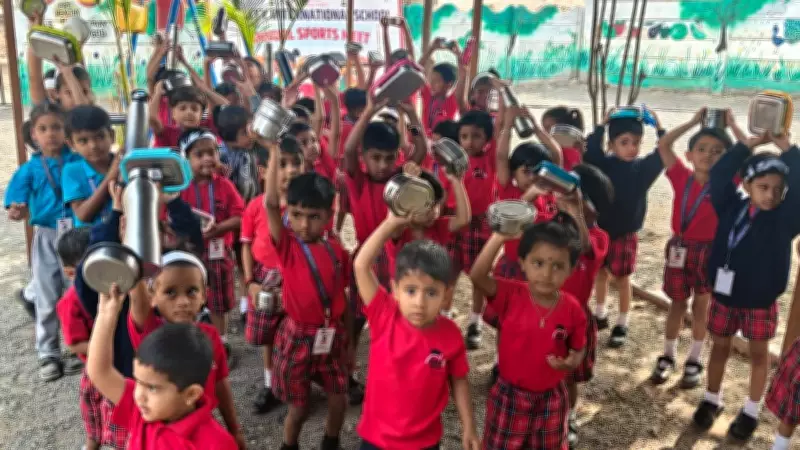
Pune's Steel Tiffin Pledge: 56,000 School Children Vow to Ditch Plastic Lunch Boxes
In a powerful environmental movement, the grounds of 104 schools in Pune resonated with a collective pledge on February 4, as 56,000 students vowed to refuse plastic lunch boxes. This initiative, known as the Steel Tiffin Pledge, is spearheaded by the Centre for Sustainable Development at the Gokhale Institute of Politics and Economics. The campaign aims to significantly reduce waste at its source by eliminating plastic, particularly materials that leach microplastics, from children's food and water containers.
A Symbolic Commitment to Health and Sustainability
The children declared, "I pledge to reduce waste in our daily lives. From June 2026, we will carry lunch in a steel tiffin regularly instead of a plastic one. A steel tiffin is a symbol — not just a box — it reminds us that our small actions matter. We will inspire our family and friends, so Pune can lead the way for India." Teachers and staff administered this oath, marking a commitment to individual actions that foster collective impact.
Aditi Deodhar, who is leading the campaign, explains, "The steel tiffin has been adopted as a symbol of individual action leading to collective impact." This pledge is part of Mission City Chakra, which focuses on empowering intermediate policymakers, such as school principals, to implement waste reduction measures on a large scale. Deodhar adds, "For school principals, the health of children is an immediate priority, so they readily come on board."

Early Adoption and Parental Engagement
Vanaz Parivar Vidya Mandir in Kothrud was among the earliest adopters, implementing the practice as part of a pilot project in 2024. Principal Anita Darwatkar recalls, "I approached our school’s society, which immediately gave us the green light. On Republic Day, our committee members, the children of the school, teachers, and many parents took the oath." The school later held a parent-teacher meeting to discuss the initiative, addressing concerns about cost and loss of tiffin boxes.
To tackle these issues, the school introduced a day when all lost tiffin boxes were displayed for children to claim. Darwatkar also educated parents on the health risks of microplastics, emphasizing that exposure through plastic containers can lead to serious diseases, including cancer. The school has achieved 100% participation, with all 680 students using only steel tiffin boxes, earning an award from a social organization for becoming plastic-free.
Children's Awareness and Advocacy
Students have shown remarkable awareness and advocacy. Jay Avinash Mohol, a Class V student, states, "Plastic ka dabbha lane se log bimar padte hain isliye aap sabko steel ka dabbha istemal karna chahiye (If people use plastic tiffins, they fall ill, so we should use steel)." Ayush Gaekwad, also in Class V, has urged his parents to reduce plastic use, while Anushree Ugalmogale has switched to steel for both her tiffin box and water bottle. Ali Rahim Sheikh, a Class IV student, notes that his chapati and bhaji stay fresh in a steel box, though some children mention that steel tiffins can leak, requiring careful wrapping to protect books.
The Global Plastic Crisis and Local Solutions
The problem of plastic waste is severe globally. According to the United Nations Environment Programme, every day, the equivalent of 2,000 garbage trucks full of plastic are dumped into the world's oceans, rivers, and lakes, with 19–23 million tonnes leaking into aquatic ecosystems annually. This pollution alters habitats, reduces ecosystems' ability to adapt to climate change, and affects livelihoods and social well-being.
Deodhar highlights that plastic tiffin boxes often remain an invisible source of pollution, even among environmentally conscious families. "We realise that policymakers exist at various levels in society. Rather than reaching out to Mumbai or Delhi for change, we can reach out to these policymakers — and one such policymaker is the school principal," she says. The campaign appeals to principals to mandate steel tiffin boxes and bottles, similar to school uniforms, given that children aged five to 15 use plastic containers daily.

Expanding Impact and Community Support
The programme began as a pilot with three school principals connected through Deodhar's work with Jeevitnadi, an organization advocating for river rights. The February pledge marks a commitment for the new academic year. At LS Jadabai English School in Katraj, principal Vaishali Mohite has long educated students on the dangers of plastic tiffin boxes, noting that in summer, heat causes plastic to leach into food. All 850 students at her school have now pledged to avoid plastic tiffin boxes and water bottles.
Srihari Suthamally, a software engineer and alumnus of the Ecological Society, supports the initiative. His daughters, aged 15 and nine, study at DriveChange Learning and Resource Centre and carry steel tiffin boxes for meals like chapati, dal, and various rice dishes. "The food is not too hot and the tiffin boxes are suitable," he says, emphasizing the family's commitment to refuse, reduce, reuse, and recycle principles.
Empowering Children as Agents of Change
After conducting 200 sessions with students, Deodhar observes that adults often underestimate children's understanding and commitment. "Parents think children want colourful or cartoon tiffin boxes. When we actually talk to children, I tell them the story of the river and the challenges we face. They understand that plastic is the issue because it is rampant in rivers," she explains. This awareness leads to a commitment from children to use steel utensils, with knowledge flowing from children to parents, driving broader community change.
This movement in Pune sets a precedent for other cities in India, demonstrating how grassroots initiatives can address environmental challenges through education, community engagement, and sustainable practices.