

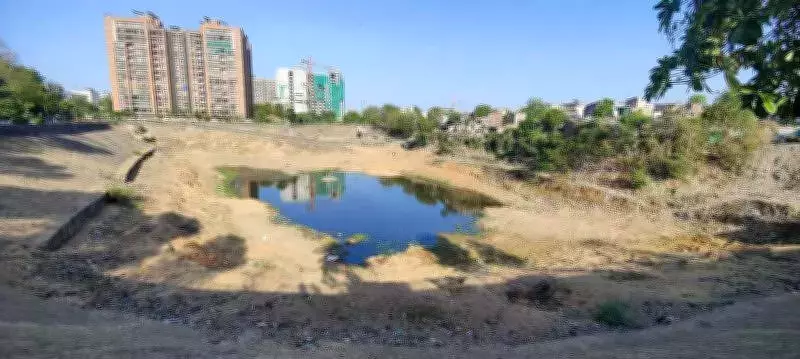
Ahmedabad's Lakes Struggle with Persistent Water Shortages
In Ahmedabad, the city's lakes are trapped in a recurring pattern of temporary abundance followed by extended periods of dryness. Over recent years, the municipal authorities have invested crores of rupees in initiatives to interlink lakes and direct rainwater into them, successfully ensuring that 89 lakes receive inflow during the monsoon season.
However, these efforts have yielded only short-term benefits, as nearly half of these lakes dry up within six months after the rains cease. This persistent issue has sparked concerns about whether the current strategies prioritize immediate inflow over sustainable, long-term water retention solutions.
Monsoon Success and Rapid Decline
During the last monsoon, 89 out of Ahmedabad's 156 lakes were replenished with rainwater, achieving filling levels between 50% and 100%. "Yet, within six months, approximately 50% of these lakes had completely dried up," noted a source within the civic body. Lakes such as Memnagar, Kaligam, Gotila Garden on Sindhu Bhavan Road, and Thaltej currently exhibit little to no water. Only a handful, including Vastrapur, Charodi, Shakari, and Sarkhej Roza lakes, continue to maintain water levels.

Ahmedabad spans an area of 480.88 square kilometers and receives an average rainfall of 900mm during the monsoon. Despite this, the existing infrastructure fails to secure year-round water retention, highlighting a critical gap in urban water management.
New Strategy: Treated Sewage for Sustained Filling
To combat this challenge, the Ahmedabad Municipal Corporation (AMC) is now formulating a plan to utilize treated sewage water to keep lakes filled throughout the year. This approach aims to provide a more consistent water supply and stabilize the city's aquatic ecosystems.
Under this initiative, sewage treatment plants (STPs) with varying capacities are proposed for 12 lakes: Asarwa, Vastral, Naroda, Motera, Shilaj, Chharodi, Gota, Nikol, Sarkhej, Saijpur, Malav, and Yadudi. Additionally, five lakes are being considered for water treatment through bioremediation methods, as per sources within the AMC.
Larger Lakes and Development Plans
According to the National Lake Conservation Plan (NLCP), lakes should ideally retain water year-round and be larger than 10 hectares, or at least 3 hectares if they hold socio-economic or religious significance. In Ahmedabad, 64 lakes exceed 3 hectares, but only three—Shilaj (18.18 hectares), Makarba (11.03 hectares), and Ramol (10 hectares)—are larger than 10 hectares.
"These three larger lakes remain undeveloped, though development plans are in progress," said a source. Officials believe that enhancing these larger lakes could play a pivotal role in bolstering the city's overall water ecosystem.
Infrastructure and Access Challenges
AMC officials point out that the issue extends beyond mere storage to include access problems. Out of the 156 lakes, 67 do not receive any rainwater at all. While 87 lakes have inlet systems to channel stormwater, two still lack such infrastructure.
An AMC official explained, "Encroachments, construction over lakebeds, and lack of civic control over certain lakes have disrupted natural water flow. Consequently, there are no stormwater lines or inlet systems to bring rainwater to these lakes. Efforts are underway to acquire control from the collector to facilitate rainwater inflow."
During the 2024 monsoon, 24 lakes, including Sola lake, were filled to 100% capacity. Of these, 14 were located in the western parts of the city and 10 in the eastern areas. Lakes in west Ahmedabad, such as Sola, Dev City, Gota, Mahila, Chandlodia, Yadudi, Chharodi, Motera, Shubham, Vistamata, Vadu, Mumatpura, Puniya, and Kothia, reached full capacity. However, the swift decline in water levels post-monsoon underscores the urgent need for more sustainable water management practices.






