

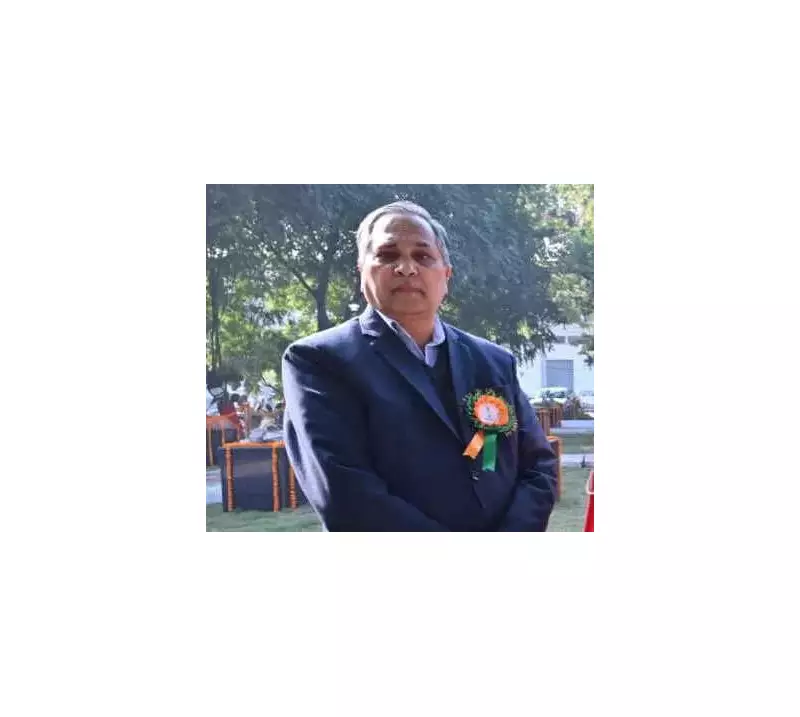
A senior scientist from the Geological Survey of India has issued a stark warning about the accelerating retreat of glaciers in the Himalayas. According to Rajinder Kumar, Additional Director General and head of GSI's Northern Region in Lucknow, a combination of air pollution, human activities, and global warming is severely impacting these vital ice reserves.
Development and Warming: A Dual Threat to Glaciers
In an exclusive discussion, Kumar pinpointed developmental work near glaciated areas and global warming as the primary drivers behind the shrinking glaciers. He emphasized that air pollution and construction-related activities are undoubtedly harming the glaciated regions. This leads to the melting of ice belts and significant alterations in glacier topography.
"If we look at the records of the past 10 years, the areas where temperatures were previously low have now increased, indicating glacier retreat," Kumar stated. He provided a striking example: even on Mount Everest, the glacier line is moving to higher altitudes, a clear sign of retreat.

Eyes in the Sky: Satellites Track the Melt
Given the extreme and challenging terrain, conventional fieldwork is often impossible. To overcome this, the Geological Survey of India is leveraging advanced remote sensing technology. Satellites like Resourcesat-1 and Resourcesat-2 are crucial tools for monitoring changes.
These satellites enable scientists to:
- Study the nature and movement of glaciers.
- Map glacial areas and track changes in their terminus (end point).
- Measure elevation and volume to assess mass balance.
- Analyze melting patterns and monitor associated hazards.
This data is fundamental for climate change studies, managing water resources, and assessing future risks.
Monitoring the Impending Danger of Glacial Lake Outburst Floods
A major focus of this satellite surveillance is the growing threat of Glacial Lake Outburst Floods (GLOFs). As glaciers melt, they often form large, unstable lakes dammed by ice or moraine. When these dams break, they can release catastrophic floods downstream.
Kumar explained that the Government of India is actively addressing the GLOF risk. The GSI complements satellite data with on-ground surveys, including boat expeditions to measure lake depth. By creating detailed mathematical maps of these lakes, scientists can calculate the total volume of water and the adjoining glacier mass. This helps in continuously monitoring lake levels and assessing the risk of an outburst.
Ice Cores: Unlocking Earth's Climate History
Beyond satellite imagery, geologists employ another powerful method to study climate change: analyzing ice cores. These ice sections act as a timeline of Earth's past atmosphere, preserving ancient air bubbles and particles like atmospheric "fossils."
"We study ice sections and note down carbon dating and mineral composition of ice," Kumar said. By comparing data from different ice cores, researchers can reconstruct historical climate patterns. This research is extensive in India and European countries experiencing similar glacier retreat, providing crucial context for current changes.
The evidence is clear and urgent. The Himalayan glaciers, often called the "Third Pole," are under severe stress from human-induced factors. Their health is directly linked to the water security of millions, making their study and protection a critical national priority.






