

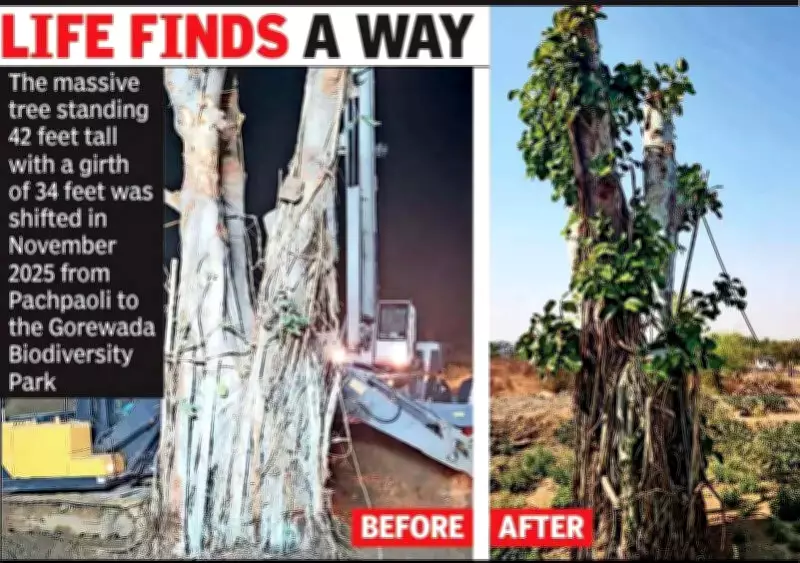
Historic Banyan Tree Shows Remarkable Recovery After Complex Relocation in Nagpur
In a significant environmental achievement, a majestic 188-year-old banyan tree that was transplanted from Pachpaoli to the Gorewada Biodiversity Park in Nagpur is demonstrating robust signs of life nearly four months after its relocation. The ancient tree, which stands an impressive 42 feet tall with a substantial 34-foot girth, is now displaying fresh foliage and rapid branch development, indicating successful adaptation to its new surroundings.
Court Intervention Prevents Felling for Development Project
The massive tree was relocated in November 2025 following a public interest litigation that intervened to prevent its felling for a proposed Nagpur Municipal Corporation e-library project. The court-mandated relocation, executed over six intensive days, culminated with the tree being carefully replanted within just 24 hours of uprooting, minimizing stress on the ancient specimen.
Expert Oversight and Scientific Methodology
Court-appointed environmental expert Dilip Chinchmalatpure, who has been overseeing the entire transplantation process, emphasized that the tree's revival underscores the critical importance of meticulous planning and sustained post-transplant care. "Most transplanted trees fail due to inadequate aftercare. Here, continuous monitoring and scientific handling made the decisive difference," he stated.

The Nagpur bench of the Bombay High Court had mandated strict supervision of the transplantation, requiring regular progress reports. Chinchmalatpure has been submitting detailed updates and will continue monitoring the tree for the next seven years to ensure its long-term survival.
Complex Extraction and Transportation Process
The transplantation presented significant technical challenges given the banyan tree's extensive root system, which typically extends nearly twice its height. Workers carefully dug trenches around the tree while preserving the delicate root ball, which was then wrapped in protective layers of gunny bags, burlap, and nets along with its original soil. Heavy machinery including cranes and hydraulic lifters transported the massive tree nearly 9 kilometers to its new home at Gorewada Biodiversity Park.
Specialized Aftercare and Growth Management
Following replantation, experts prepared a specialized soil mixture using black soil, cow dung, neem cake, and essential micro-nutrients to support regrowth. Root hormones were applied to aid anchoring, while fungicides protected pruning wounds from infection. "Encouragingly, the tree has developed nearly 100 new branches. We are now planning selective pruning, or debranching, to reduce these to around 10, ensuring structural stability and balanced growth," Chinchmalatpure explained.
Resilience Against Environmental Challenges
Remarkably, the tree has shown exceptional resilience despite being transplanted outside the ideal monsoon or winter window, enduring temperatures reaching 40°C. Environmental officials believe this success could establish a valuable benchmark for future urban tree relocation projects, demonstrating that with proper expertise and dedicated care, even centuries-old trees can be preserved amid increasing development pressures.
The successful transplantation offers hope for urban conservation efforts nationwide, proving that ancient natural heritage can coexist with modern development when approached with scientific methodology and sustained commitment.






