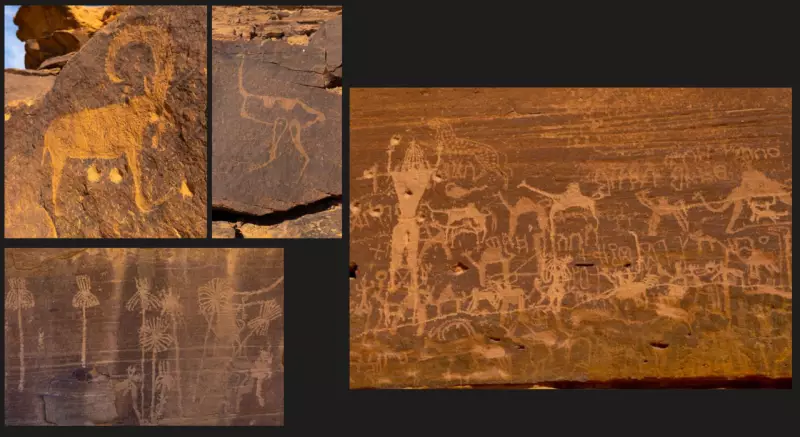
Today, Saudi Arabia stands as a modern, oil-rich nation channeling vast investments into infrastructure and diversifying its economy for a post-fossil fuel future. Yet, it is simultaneously one of the planet's most arid countries, with approximately 95 percent of its land covered by desert, including the vast Rub’ al Khali, or Empty Quarter. This stark contrast fuels ambitious national projects like the pledge to plant 10 billion trees to combat desertification. However, groundbreaking scientific discoveries now reveal that this extreme dryness is not the peninsula's natural, permanent state. Multiple independent studies conclude that Arabia was once a humid, green landscape crisscrossed by rivers and lakes, sustained by monsoon rains that supported both wildlife and repeated waves of human settlement.
From Ice Age to Green Oasis: Arabia's Hidden History
The story of Green Arabia primarily unfolds during the Pleistocene Epoch, stretching from about 2.6 million to 11,700 years ago. While this period is commonly known as the Ice Age for the glacial cycles in the Northern Hemisphere, it triggered dramatic shifts in rainfall patterns worldwide. During its wetter phases, the Arabian Peninsula transformed. Instead of endless sand dunes, it blossomed into grasslands, savannahs, and a network of rivers and large lakes. This environment was capable of sustaining life for extended periods, not just serving as a harsh corridor for brief migrations.
This finding fundamentally overturns older assumptions. Professor Michael Petraglia, a leading expert in human evolution and prehistory from the University of Oxford and now at Griffith University, explains the evidence. "Innovative space shuttle technology has allowed the mapping of over 10,000 ancient lakes across Arabia, including the now-barren Nafud desert," he told the BBC. This technological view from space reveals vast, now-dry river systems. The discovery of remains from elephants, hippos, crocodiles, and molluscs at archaeological sites in the kingdom directly corroborates the satellite data, as these animals depend entirely on abundant, lasting water sources.

The Empty Quarter's Watery Secret and Climate Drivers
A compelling line of evidence comes from the heart of the desert itself. A recent study published in Communications Earth & Environment, led by scientists at King Abdullah University of Science and Technology (KAUST), focused on the Rub’ al-Khali. This region, now the world's largest continuous sand desert, once held massive lake and river systems.
Researchers, including Antoine Delaunay from KAUST, identified an ancient lake covering roughly 1,100 square kilometres and reaching depths of up to 42 metres. During a pronounced "Green Arabia" phase between approximately 11,000 and 5,500 years ago, intensified rainfall caused this lake to overflow. The event carved a 150-kilometre-long valley into the desert floor. The study, which traced sediments across more than 1,000 kilometres, attributes these rains to the northward expansion of African and Indian monsoon systems.
"Beneath Rub’ al Khali’s desolate sands lies a vibrant past of lakes and rivers," Delaunay stated. "Our study highlights the transformative power of the climate on Arabian landscapes and their profound connection to human occupation."
Human Migration and Modern Echoes of a Green Past
These green phases were not uniform; they lasted millennia in the south and centuries in the north. Nevertheless, they repeatedly created habitable corridors that shaped human history. According to Petraglia, the formation of lakes, rivers, grasslands, and savannahs "would have facilitated the expansion of hunting, gathering, and pastoral groups into what is now a dry, barren desert." This is confirmed by abundant archaeological evidence found within the Empty Quarter and along its ancient waterways.

Around 6,000 years ago, rainfall sharply declined, returning the region to aridity and forcing populations to move once again. These scientific insights align with views from within the kingdom. Prince Sultan bin Salman bin Abdulaziz, head of the Saudi Commission for Tourism and National Heritage, has noted that dramatic climate changes during the middle Pleistocene encouraged early humans to make the then-green peninsula their destination after leaving Africa.
These revelations about a green antiquity resonate powerfully with Saudi Arabia's contemporary environmental ambitions. Through the Saudi Green Initiative, the kingdom is committed to planting 10 billion trees and rehabilitating about 74.8 million hectares of degraded land long-term. Official figures state that by mid-2025, over 151 million trees and shrubs had already been planted and around 500,000 hectares restored. The interim 2030 target is to exceed 600 million trees, utilizing native species, treated wastewater, and advanced technology like drone-assisted planting.
As Saudi Arabia leverages its capital and modern science to reshape its future beyond oil, a critical question emerges: Can one of the world's most arid regions use this combination of scale and historical knowledge to revive echoes of its own Green Arabia? The answer could provide a vital model for desert nations globally facing the intertwined challenges of land restoration and climate adaptation.