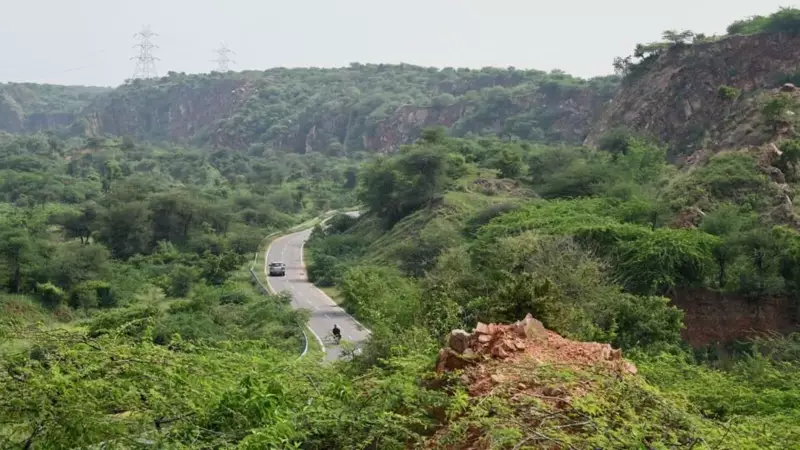
As severe air pollution continues to choke the Delhi-National Capital Region (NCR), a fresh environmental controversy has erupted, this time centred on the protection of the ancient Aravalli mountain range. Environmentalists, citizen groups, and opposition parties are raising alarms that a proposed legal definition could strip robust safeguards from over 90% of the range's crucial landscapes.
The Core of the Controversy: A New Definition
In November 2025, the Supreme Court accepted a uniform legal definition for the Aravalli Hills and Range, based on recommendations from a committee led by the Union Environment Ministry. According to this new framework, an "Aravalli Hill" is defined as a landform with an elevation of at least 100 metres above its local surrounding terrain. An "Aravalli Range" is defined as a cluster of two or more such hills within 500 metres of each other.
Critics, including groups like People for Aravallis, scientists, and political parties such as the Congress and Samajwadi Party, argue this height-based criterion is dangerously restrictive. They contend it would exclude more than 90% of the range's ecologically vital low-lying ridges, foothills, and scrublands from stringent environmental protection.

Potential Consequences: Desertification and Pollution
The warnings from experts are stark. They fear that weakened protection could unlock the door for increased mining, expansive real estate projects, and unchecked urban sprawl. The potential fallout includes:
- Accelerated desertification, as the Aravallis act as a critical natural barrier preventing the eastward spread of the Thar Desert.
- Depletion of groundwater recharge zones that feed rivers like the Chambal and Luni.
- Irreversible erosion of biodiversity and habitat loss.
- Worsening air pollution and water scarcity across north India, including Delhi-NCR.
Dr. Manish Kumar, a climate scientist and director of the Sustainable Bharat Foundation, explained the direct link to Delhi's air quality. "The Aravallis act as a natural barrier that helps limit dust transport and influences regional wind patterns," he said. Degradation could increase dust loading towards Delhi-NCR, especially during dry, windy conditions.
Government's Assurance and the Stakes for North India
In response to the growing concerns, Union Minister for Environment, Forest, and Climate Change Bhupender Yadav offered assurances on Monday. He stated the government is committed to keeping the hills safe and that the reclassification aims to bring uniformity in enforcing environmental laws across states. Yadav clarified that only 0.19% of the entire 1.44 lakh square kilometre range has been opened to mining, affecting an expected 277.89 square kilometres, and that no new mines are being opened.
However, the stakes remain extraordinarily high. The 670-kilometre-long Aravalli range, dating back 2 billion years, is not just a collection of hills. It is a fundamental ecological pillar for north India:
- It blocks hot, dry desert winds, protecting the fertility of the Indo-Gangetic plains.
- It acts as "green lungs" for Delhi-NCR, trapping dust and absorbing particulate pollution.
- Its fractured geology allows deep percolation of rainwater, recharging aquifers for millions in water-stressed regions.
- It is integral to India's commitments under the UN Convention to Combat Desertification.
The debate now hinges on implementation. Environmentalists stress that while the Supreme Court sought clarity, the functional ecological value of lower hills, slopes, and recharge zones must be captured in scientific mapping and management plans. The health of Delhi-NCR, they argue, is inextricably linked to preserving these surrounding natural systems that regulate temperature, ensure water security, and mitigate the stresses of rapid urbanisation.