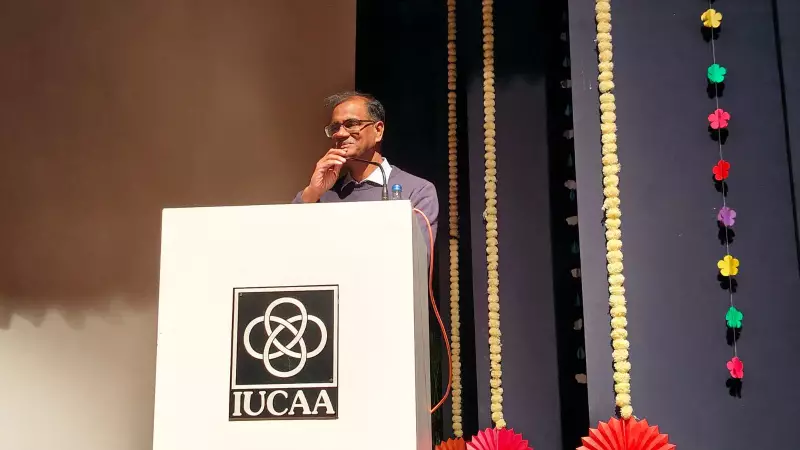
Mining activities in the ecologically sensitive Aravalli hills are primarily driven by the massive demand for construction materials like limestone and cement, rather than the extraction of strategic minerals, a leading academic has highlighted. This revelation underscores a critical environmental debate unfolding alongside India's infrastructure push.
The Core Demand: Building Homes, Not Securing Minerals
Speaking at the 37th foundation day of the Inter-University Centre for Astronomy and Astrophysics (IUCAA) in Pune, Professor Mahesh Rangarajan from Ashoka University dissected the real impetus behind the mining. "Aravali mining is not only about legal definitions," he stated. "It is used for the manufacture of limestone and cement, for which there is a lot of demand. We are going to be building homes in the country. It is a construction industry."
His comments bring to the fore the urgent need for exploring alternative, sustainable construction materials to reduce pressure on vital mountain ecosystems.

A Profound Geological Transformation
Professor Rangarajan framed the scale of extraction in stark, almost mythical terms, pointing to consequences beyond immediate ecology. He warned that the mining is altering fundamental natural systems. "...we are not only transforming the hydrology, the soil cover and the taxa, the living forms, the hydrosphere, we may be transforming the basic geology of ourselves," he told the audience.
"This is a very profound transformation, obliterating a mountain. It is something you read about in ancient stories as a miracle, it is happening now, but is it a miracle or a tragedy? And here is the nerve of the problem, one person’s miracle is another’s tragedy."
Legal Turbulence and Multi-State Complexity
The issue remains legally contested. On the same day as the lecture, the Supreme Court stayed its own November 20 order that had accepted a 100-metre height definition for the Aravallis. Responding to public concern, the court decided to form a new expert committee with domain specialists to resolve critical ambiguities.
Rangarajan noted the complexity of the issue, spread across multiple states with active democratic oversight. "The Aravallis…are not only in Rajasthan, they are also in Haryana and other adjacent states," he said, adding that more than one political party is in power in three of the four involved states, fostering debate.
He contrasted India's path with China's historical 'Great Leap Forward', emphasizing India's "very active public debate" involving court hearings, ministerial clarifications, and questions from opposition parties and citizen groups.
He also stressed the importance of including local communities in the conversation: "..we need to bring in here the question of the livelihoods of people who depend on those resources. They shouldn’t be left out... the small producer, the wage earner, the herder."
India's Global Role and Citizen Power
Beyond the Aravalli issue, Professor Rangarajan highlighted India's indispensable role on the world stage. "You can’t think of the future of humanity without looking at a sixth of humanity," he asserted, underlining the country's demographic and strategic significance.
He credited an engaged citizenry for past environmental successes, like the enactment of key laws in the 1970s and 80s and the remarkable doubling of tiger numbers. "An active, engaged citizenry, which has the ability to question on the basis of reason, which can draw on scientific knowledge, has a larger role today to play than ever before," he stated.
Climate Change: An Infinitely More Complex Challenge
The historian-environmentalist also reflected on the unparalleled complexity of tackling global warming compared to past international agreements. He cited the 1963 Partial Nuclear Test Ban Treaty and the 1987 Montreal Protocol as examples where a limited set of countries or specific technologies were involved.

"The problem with global warming or global climate change is infinitely more complex," he said. "(Climate change) is much more complex because dealing with the biosphere is complex. It has been complex for centuries." He pointed out that effective climate action requires consensus and action from all nations, making it a uniquely difficult geopolitical and environmental puzzle.