The Arctic, Earth's frozen northern frontier, is undergoing a transformation so rapid it is redrawing the maps of climate science, global trade, and international power dynamics. The recently published 'Arctic Report Card 2025' by the National Oceanic and Atmospheric Administration (NOAA) delivers a stark warning: the region has just experienced its highest air temperatures in the last 125 years of recorded history. This is not an isolated spike; the last decade now stands as the ten warmest years on record for the Arctic.
A Region in Rapid Transition: From Ice to Opportunity
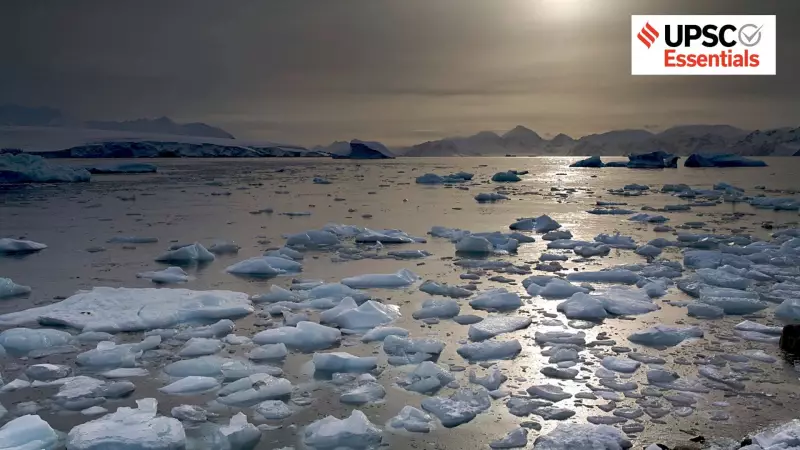
The evidence of change is overwhelming and interconnected. Shrinking glaciers, a steadily warming ocean, and unprecedented extreme weather events are becoming the new normal. A critical indicator, sea ice, is vanishing at an alarming pace. March 2025, typically the month of maximum ice extent, recorded the lowest coverage in 47 years of satellite records. Even more concerning is the fate of the oldest, thickest ice, which has declined by over 95% since the 1980s.
This dramatic thaw, while fueling global climate anxieties, is simultaneously unlocking the region's frozen economic potential. New maritime corridors like the Northern Sea Route (NSR) are becoming navigable, promising to slash shipping times between Europe and Asia by up to 40% compared to the Suez Canal route. Furthermore, vast reserves of oil, natural gas, and critical minerals lie beneath the retreating ice, attracting global interest.

Geopolitical Heat in a Melting Arctic
The opening of the Arctic has ignited a complex geopolitical competition. The region is governed by the eight-nation Arctic Council, but cooperation has frayed, particularly following Russia's actions in Ukraine and the subsequent NATO membership of Finland and Sweden. This leaves Russia isolated within the council and keen to find partners for its ambitious NSR development plans, which require massive investment in infrastructure and icebreaker technology.
Non-Arctic states are also staking their claims. China, self-declaring as a 'near-Arctic state', has integrated the region into its Belt and Road Initiative through the 'Polar Silk Road'. India, too, is articulating a clear vision for its role. The recent India-Russia joint statement during President Vladimir Putin's visit to Delhi highlighted India's interest in active involvement in the Arctic Council and deepening cooperation in the Russian Far East and Arctic, specifically via the NSR.
India's Arctic Ambitions: Science, Strategy, and Sustainability
India's connection to the Arctic is long-standing, dating back to the 1920 Svalbard Treaty. Its modern engagement began with the establishment of the 'Himadri' research station in Svalbard in 2008 and its observer status in the Arctic Council in 2013. This engagement was formalized with the release of India's Arctic Policy in 2022, built on six pillars:
- Strengthening scientific research and cooperation.
- Climate and environmental protection.
- Economic and human development.
- Transportation and connectivity.
- Governance and international cooperation.
- National capacity building.
For India, the Arctic is not a distant concern. Scientific studies, including those from India's National Centre for Polar and Ocean Research (NCPOR), indicate that Arctic melting can influence upper atmospheric circulation, potentially increasing the unpredictability of the vital Indian Summer Monsoon Rainfall (ISMR). Economically, the Chennai-Vladivostok maritime corridor, operational since 2024, and future NSR access could revolutionize trade logistics and energy security.
Unlike Antarctica, which is protected by an international protocol, the Arctic lacks robust frameworks to shield its environment from commercial exploitation. India's experience in the Himalayas and Antarctica positions it to advocate for sustainable and inclusive governance. The future of the Arctic will increasingly be shaped by the interplay between traditional Arctic states and emerging stakeholders from the 'Third Pole,' making India's scientific diplomacy and constructive engagement more critical than ever.