Astronomers Discover Bizarre 'Inside-Out' Planetary System
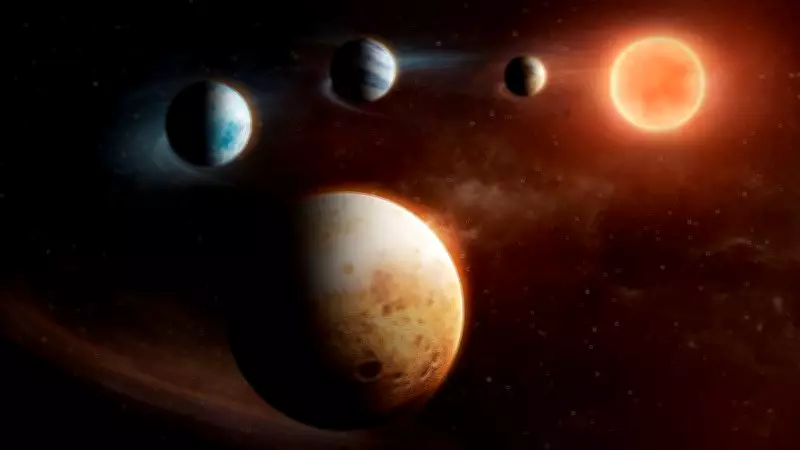
In a groundbreaking discovery that has left scientists scratching their heads, astronomers have identified a planetary system located approximately 117 light-years from Earth that defies conventional understanding. This system, observed through advanced telescopic technology, exhibits a peculiar configuration where the inner planets are significantly larger than their outer counterparts, a phenomenon described as an "inside-out" arrangement.
Challenging Established Theories of Planet Formation
The discovery poses a direct challenge to current astrophysical models, which typically predict that planets form in a more orderly fashion, with smaller, rocky bodies closer to their host star and larger, gaseous giants situated farther out. In this newly found system, however, the inner region is dominated by massive planets, while the outer zones contain smaller bodies, upending decades of scientific consensus.
This anomalous structure suggests that our understanding of planetary formation may be incomplete or that unique cosmic events have reshaped this system over time. Researchers are now investigating potential explanations, including gravitational interactions, migration of planets, or unusual conditions during the system's early development.

Implications for the Search for Habitable Worlds
The findings have profound implications for the ongoing search for habitable exoplanets and life beyond Earth. If such "inside-out" systems are more common than previously thought, it could alter the criteria used to identify potentially life-supporting planets. Astronomers emphasize that this discovery highlights the diversity of planetary architectures in our galaxy and underscores the need for continued exploration and observation.
Further studies are planned to analyze the composition and atmospheres of these planets, which may provide clues about their formation history and the possibility of habitability.
Future Research Directions
Moving forward, astronomers aim to:
- Conduct detailed spectroscopic analyses to determine the chemical makeup of the planets.
- Use computer simulations to model possible formation scenarios for the "inside-out" configuration.
- Search for similar systems in other parts of the galaxy to assess how common this phenomenon might be.
This discovery serves as a reminder of the vast unknowns in our universe and the endless possibilities for scientific advancement. As technology improves, astronomers expect to uncover even more exotic planetary systems, pushing the boundaries of human knowledge.