

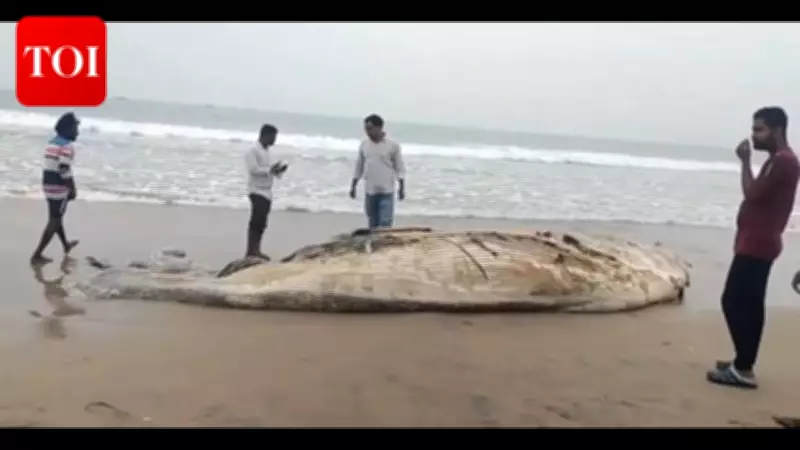
Massive Baleen Whale Carcass Discovered on Paradip Beach in Odisha
The carcass of a baleen whale, measuring approximately 30 feet in length, washed ashore on Paradip beach within the Bhitarkanika National Park in Kendrapada district, Odisha, on Tuesday. This unusual event has generated significant curiosity and attention among local residents and marine fishermen in the region.
Discovery and Initial Response
A group of fishermen returning from the sea first spotted the massive carcass and immediately alerted others in the community. Soon after, numerous locals flocked to the beach, capturing photographs and videos of the deceased whale and sharing them widely across social media platforms. Krishna Rao, a 40-year-old resident of Paradip, stated, "We saw a giant whale carcass on the beach on Tuesday morning."
Forest officials from the Kujang range promptly rushed to the location after being informed by villagers. Upon inspection, they found the whale's body to be highly decomposed, with visible scars and indications of previous entanglement. Sanjay Kumar Pradhan, the range officer of Kujang, explained, "Entanglements are common among baleen whales due to their feeding habits. The animal may also have been struck by a ship or fishing vessel in deep waters. Following its death, the carcass eventually washed ashore."

Investigation and Conservation Significance
A team of veterinary experts collected viscera samples from the carcass and dispatched them to the Odisha University of Agriculture & Technology (OUAT) in Bhubaneswar for detailed analysis. Pradhan added, "The exact cause of death will be determined after the laboratory report is received. Our teams are currently guarding the carcass to ensure its preservation."
Herpetologist and taxidermist Siba Prasad Parida identified the carcass as belonging to a baleen whale. He elaborated on its ecological importance, noting, "Baleen whales, also referred to as toothless whales, utilize baleen plates to filter food from water. They are protected under Schedule I of the Wildlife Protection Act, 1972, and are classified as 'endangered' by the International Union for Conservation of Nature (IUCN)."
This incident underscores the ongoing challenges faced by marine wildlife, including threats from human activities such as shipping and fishing. The analysis from OUAT is anticipated to provide further insights into the whale's demise, potentially informing conservation strategies to safeguard these majestic creatures in the future.






