Ancient Soil Core in Bandhavgarh Unlocks 2,600 Years of Climate and Human History
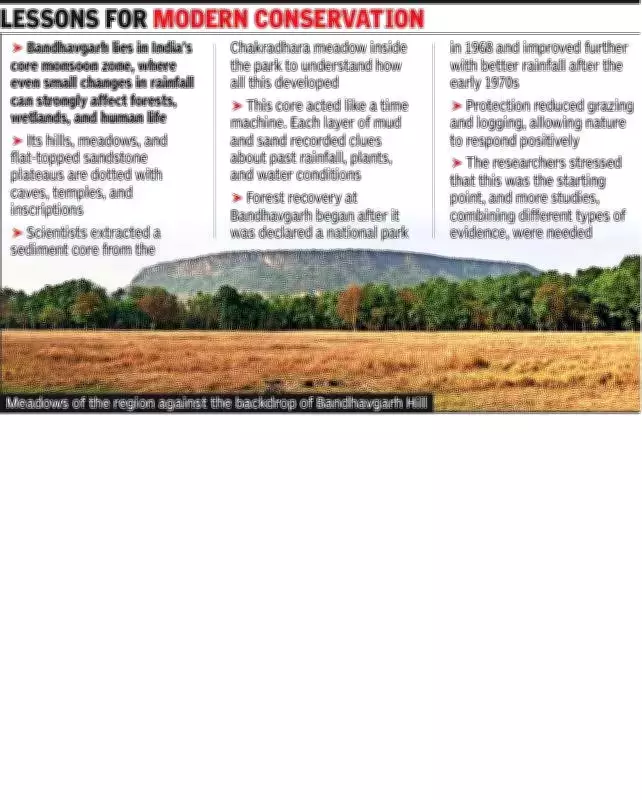
Deep within the dense forests of Bandhavgarh in Madhya Pradesh, scientists have unearthed a remarkable chronicle preserved in the earth itself. A narrow sediment core, measuring just 60 centimeters in length, has provided researchers with unprecedented insights into how climate patterns influenced human societies in this region for nearly 2,600 years.
This groundbreaking research, recently published in the esteemed Holocene journal, directly challenges the widespread assumption that climate change inevitably leads to societal collapse. Instead, it paints a nuanced picture of human adaptation and resilience across centuries of environmental fluctuation.
A Collaborative Scientific Endeavor
The study was a major interdisciplinary collaboration involving experts from several premier Indian institutions. The team included scientists and historians from the Birbal Sahni Institute of Palaeosciences, Ashoka University, the Agharkar Research Institute, the Indian Institute of Tropical Meteorology, and the Academy of Scientific and Innovative Research.

"Today, Bandhavgarh is globally renowned as a critical tiger reserve," the research paper notes. "However, long before its designation as a protected forest, this landscape was a vibrant home to communities who lived, farmed, constructed intricate caves and temples, and managed water resources through countless generations of variable rainfall."
The core finding is profound: while climatic shifts undoubtedly shaped the surrounding environment, they did not singularly dictate human destiny. Societies demonstrated remarkable capacity to adapt and persist.
Human Presence as a Constant Through Climate Phases
Professor Nayanjot Lahiri from Ashoka University's Centre for Interdisciplinary Archaeological Research, a co-author of the study, emphasized this continuity. "Despite significant climate shifts, the one unwavering constant here is the expansion of human occupation from ancient to medieval times," Lahiri stated. "Even amidst changing ecological conditions, the imprint of a substantial and enduring human presence is strikingly evident."
To decode the historical record, the research team employed a sophisticated suite of five scientific methods:
- Mineral Magnetism: Analyzing magnetic properties of soil minerals.
- Grain-Size Analysis: Studying sediment particle sizes.
- Diatom Analysis: Examining microscopic water plants as environmental indicators.
- Pollen Analysis: Identifying ancient plant species from preserved pollen grains.
- Elemental Chemistry: Assessing the chemical composition of the soil layers.
By first mapping climate changes independently and then correlating them with the archaeological timeline, the researchers identified five distinct climatic phases spanning from approximately 525 BCE to the present day.
Five Millennia of Adaptation Revealed
Phase 1 (c. 700-400 BCE): This earliest period was characterized by frequent oscillations between wet and dry conditions. Evidence of stone tools indicates the presence of hunter-gatherers, while cereal pollen suggests the concurrent beginnings of agricultural practice. During wetter intervals, moist deciduous forests expanded across the region.
Phase 2 (c. 400 BCE - 300 CE): A trend towards drier conditions emerged, with falling water levels and visible plant stress. Contrary to expectations, this period saw a surge in human architectural activity, marked by the creation of large-scale rock-cut caves, demonstrating a shift rather than a decline in societal engagement.
Phase 3 (c. 300-700 CE): A return of robust monsoon rains fostered healthy sal forests and stable wetland ecosystems. Archaeological evidence shows an expansion in cave usage, underscoring a continuity of settlement during this favorable climatic window.

Phase 4 (c. 700-1600 CE): This era presented the most severe test, as Bandhavgarh experienced its driest recorded conditions. Far from abandoning the area, the ruling Kalachuri dynasty responded with ingenuity, constructing temples, tanks, and sophisticated water-harvesting systems to secure vital resources.
Phase 5 (c. 1600 CE - Present): The modern era, leading to the region's current status as a protected forest.
Local Geography and Ingenious Water Management
A key revelation from the diatom analysis was the role of local geography in fostering resilience. Even during periods of weakened monsoon, Bandhavgarh's unique landscape helped retain water, providing a buffer against drought.
"We observed large-scale catchment activity through the diatom record," explained co-author Karthick Balasubramanian of the Agharkar Research Institute. "Disturbances in the catchment area were clearly reflected by shifts in the diatom communities. This local environmental stability enabled populations not just to survive, but to thrive and develop."
This comprehensive study from the heart of Bandhavgarh offers a powerful corrective to deterministic narratives about climate and society. It highlights a 2,600-year legacy of human adaptability, where changing rains prompted innovation in agriculture, architecture, and water conservation, proving that environmental challenge has often been a catalyst for societal ingenuity rather than a sentence of collapse.