

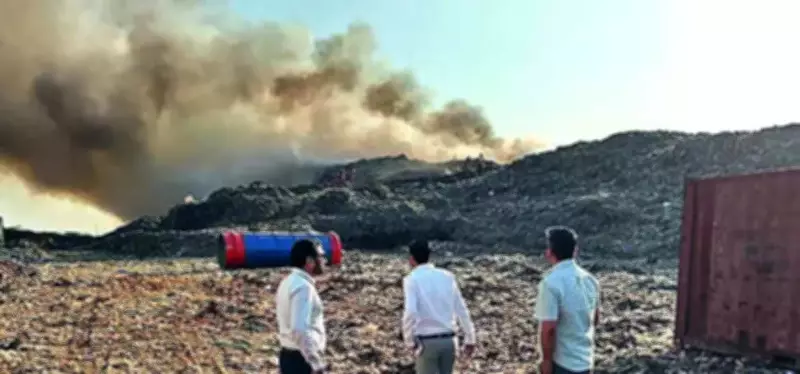
Bandhwari Landfill Fire Highlights Critical Safety Lapses in Methane Monitoring
In a significant environmental and safety breach, a recent fire at the Bandhwari waste treatment plant in Gurgaon has exposed severe failures in methane monitoring systems. Officials from the Haryana State Pollution Control Board (HSPCB) confirmed that the methane detection mechanisms at the site were non-functional, failing to alert authorities to dangerous gas concentrations. This lapse occurred just a day before a blaze erupted, underscoring persistent regulatory weaknesses at one of the National Capital Region's most critical landfill sites.
HSPCB Inspection Reveals Multiple Violations of CAQM Directives
The HSPCB's regional office conducted a thorough site inspection on Wednesday, identifying widespread "non-compliance" with essential safety protocols. Regional Officer Akanksha Tanwar detailed that the inspection flagged inadequate temperature regulation, a mandatory requirement under Commission for Air Quality Management (CAQM) norms, which significantly increases the risk of spontaneous combustion. The findings specifically point to violations of CAQM's Direction No. 91, issued under Section 12 of the CAQM Act, which mandates robust methane detection systems, continuous temperature monitoring of waste heaps, and immediate fire response protocols.
Tanwar emphasized, "The team found that methane detection was not functioning effectively and temperature control measures were inadequate. There was also a delay in controlling the fire at the site. We have been imposing a penalty of Rs 10 lakh every month on the Municipal Corporation of Gurgaon (MCG) for violations at Bandhwari and will take further action as required." She added that MCG is obligated to implement all preventive and safety measures in alignment with CAQM directives, but has consistently failed to do so.

Root Causes and Historical Context of Recurring Fires
Officials investigating the latest incident pointed to a likely trigger: on the day of the fire, bio-culture was sprayed on waste heaps as part of routine landfill treatment. Experts note that such microbial activity accelerates decomposition, leading to increased internal heat generation and methane release. "In poorly monitored landfill conditions, this combination can cause a rapid temperature rise and ignition, especially during dry weather," an official explained.
Bandhwari landfill has a long and troubled history of fires, repeatedly flagged by courts and environmental agencies. In April 2025 alone, multiple blazes were reported on April 3, 6, 21, and 26, with one major fire taking nearly two days to control despite deployment of fire tenders from multiple districts. Another significant fire between April 26 and 27 required over 20 hours to extinguish, highlighting the intense scale of these incidents.
MCG officials have often attributed these fires to methane accumulation from decomposing waste, coupled with poor monitoring and delayed response mechanisms. However, environmental activist Vivek Kamboj argues that the recurring blazes signify systemic regulatory failure rather than isolated accidents. "When basic safeguards like methane detection and temperature monitoring, mandated by CAQM, are either non-functional or ignored, fires become inevitable. Bandhwari has been burning for years, yet enforceable accountability is missing. Without strict compliance, directions remain merely on paper," he stated.
Ongoing Environmental and Regulatory Challenges
Operational since 2008, the Bandhwari landfill spans 29 acres and rises nearly 38 metres, continuing to receive approximately 2,200 metric tonnes of waste daily despite lacking a full-scale treatment facility. Situated near the ecologically sensitive Aravali zone, it has faced sustained criticism for frequent fires, legacy waste accumulation, and environmental violations.
CAQM directives require:

- Installation of methane gas detectors
- Continuous temperature monitoring of windrows
- Firefighting infrastructure
- Preventive protocols such as regular patrolling and mock drills
Despite these requirements, systems at Bandhwari have been either ineffective or improperly implemented, leading to repeated fire incidents. The HSPCB is now initiating enforcement actions, with sources indicating that penalties and further directives to ensure compliance are likely. Authorities are expected to demand a detailed compliance report from plant operators.
Judicial Interventions and Future Actions
The National Green Tribunal (NGT) has been actively monitoring the situation. In March, it directed MCG to develop a comprehensive action plan for waste handling and remediation at Bandhwari, noting that no such plan exists despite the site receiving thousands of tonnes of garbage daily. The landfill has long been under NGT scrutiny due to issues like waste mismanagement, leachate leakage, and environmental damage.
In November of the previous year, the tribunal reprimanded the Haryana government for failing to comply with earlier directives, as toxic leachate continued to spill into adjacent green areas. It ordered the state's principal secretary for environment to explain the delays and imposed a cost of Rs 50,000 for seeking additional time to file a compliance affidavit. Earlier inspections had also flagged concerns about leachate overflowing through kutcha drains into plantation areas, forming stagnant pools that could potentially spread to agricultural fields during heavy rainfall.
This latest fire at Bandhwari reinforces urgent calls for stricter enforcement and accountability to prevent future preventable incidents, safeguarding both public safety and the environment.





